|

|
|
|

|

|
|
The First Migration: The Algonquian People
|
|
|
The Sons of Abimael:
The Story


|
|
|
And Joktan begat... Abimael
Abimael was the seventh son of Joktan, of the thirteen sons who left Mesopotamia with their parents and which family proceeded to accomplish something that no one had ever done before, that is to journey across a vast uncharted region of the Earth, known today as the continent of Asia, eventually crossing
Beringia over a land bridge onto what was likely unbeknownst to them at the time would later be called the North American continent.
The existence of the land bridge, according to today′s wise men, occurred during the close of what they say was the last glacial period, now more commonly referred to as the
Last Ice Age, when the Earth′s oceans were likely two hundred feet lower, allowing Joktan and his family to make that crossing happen.
Thus, that first migration, which, also according to this world′s wise men, likely was initiated from Ur of the Chaldean. Nevertheless, that crossing of those ancient wayƒarers did occur; those travelers, now known as the indigenous people of
North America did arrive; and subsequently, those travelers walk inland throughout many areas of the
North American continent; and those people continued to explore and settle their homelands as far east as the eastern coastal lands of the continent.
The Homelands
Upon crossing the land bridge, Joktan and his family begin their travel onto the new continent, and at times, one of the Sons of Joktan would choose to depart from his father and settle at a choice location; or to travel on a different path and/or along a different river. Every time any of his sons were to make the decision to depart company from their father, Joktan would stop, set up his camp and spend time there with that son′s family before their imminent departure.
So, on any such occasion, when ever Joktan would learned that one of his Sons was going to leave the main contingent, Joktan tells that son that he will not be leaving in the morning, but will instead continue to camp here so that he can not only visit with that son′s family in order to bid them each one a goodbye, but even more important, so that he would have another opportunity, to do as he has done so frequently did with all of his sons when they chose a departing paths, that is to tell these of his grandsons and great grandsons the words of the Story Keepers.
Yes, Joktan had been assigned that position of
Story Keeper along with his sibling Peleg when they both were asked into the tent of their great-grand-father Shem.
The Sons of Abimael
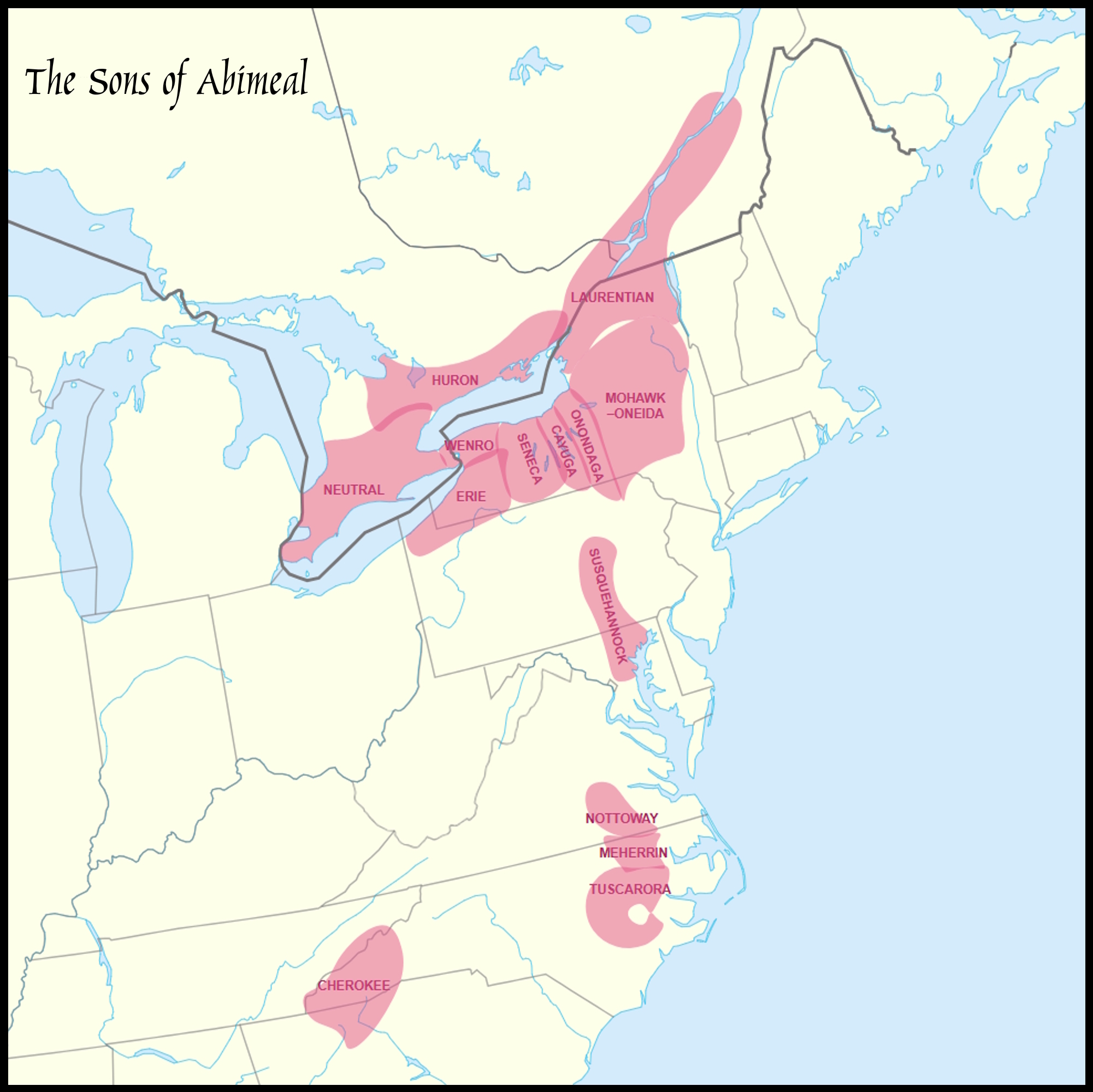
Who are the sons of Abimael? First, know that Abimeal had fifteen sons, a large family indeed. Also, Abimael was the father of those indigenous people who later came to be known as the Iroquois Nation of indigenous people. Then, third, due to those many sons each having different perspectives of what the understanding of homeland meant to them, the nation of Abimael was separated into two great Nations of Tribes now known as the Northern Iroquois Nation and the Southern Iroquois Nation.
Northern Iroquois
The first great Nation was the Northern Iroquois whose homeland became the lands surrounding the upper Saint Lawrence River in what is now Canada, the eastern Great Lakes area in both what is now Canada and the United States, and finally most of the region of which is now New York State as well as some areas in the state of Pennsylvania. All of the indigenous tribes together were known as the Haudenosaunee Confederacy who, before 1722, were known as the Five Nations.
Southern Iroquois
The second great Nation were the Southern Iroquois whose homeland became the lands along the Atlantic rivers and bays within Virginia and North Carolina which included: the indigenous tribes of the Nottoway along the river of the same name in Virginia; the tribes of the Meherrin along the river of the same name on the border between Virginia and North Carolina; and the Tuscarora along the Roanoke and other rivers in North Carolina who later migrated north to become the sixth nation of the Haudensoaunee Confederacy.
Included with the Southern Iroquois were two other tribes who had separated from the main contingency of the nation and moved elsewhere. These two tribes were known as the Cherokee and Susquehannock.
|
| |
|
The Sons of Abimael,
The People
|
|
|
The Southern Iroquois
The Cherokee Indigenous Tribe
The Cherokee are North American indigenous people of Iroquoian lineage who at the time of the European colonization of the Americas was considered to be one of the largest politically integrated tribes anywhere on the Atlantic inland Woodlands regions of what is now the United States. They are believed to have numbered more than 23,000 individuals in the mid 1600s, and their homeland comprised of as much as 50,000 square miles of the Appalachian Mountains in areas of present-day northern Georgia, eastern Tennessee, and the western parts of what are now North Carolina and South Carolina.
Traditional Cherokee culture emphasized community, political participation, and spiritual beliefs, including a worldview of three interconnected worlds: the underworld, middle world, and upper world. Women historically played active roles in decision-making councils, reflecting a participatory and inclusive social structure.
The Language:
ᏣᎳᎩᎪ ᎠᏰᎵ
The Cherokee language, Tsalagi Gawonihisdi, belongs to the Iroquoian language family and is an critically endangered-to-moribund Iroguoian language, which is the native language of the Cherokee people now living in northeast Oklahoma and Cherokee is the only Southern Iroquoian language spoken today. Despite the possible thousands of years of separation between the Southern Iroquoian language speakers from those speakers of the Northern Iroquoian languages, the Cherokee language still shows similarities to the those of the Mohawk, Onondaga, Seneca and Tuscarora.
The publication of the Ethnologue lists the Cherokee language as a Living language however, state that it is an endangered-to-moribund Iroguoian language, The publication continues to state that there were only 1,520 Cherokee speakers down from 376,000 Cherokees in 2018. The Tahlequah Daily Press reported in 2019 that most speakers are elderly, about eight fluent speakers die each month, and that only five people under the age of 50 are fluent. The dialect of Cherokee in
In the 19th century, the Cherokee developed a written syllabary, enabling literacy and record-keeping.
The School for the Language
In 2001, the Cherokee Immersion School, located in Tahlequah, Oklahoma, began as a language preservation program. This new elementary school instructs students from pre-kindergarten through sixth grade using the Cherokee language with a bridge program for seventh and eight grade student desiring to go to public schools or the Sequoyah High School.
The Sequoyah High School, founded in 1871, is a Cherokee is a Native American boarding school serving students in grades 7 through 12 who are members of the federally recognized Native American tribe. The school is located about five miles south of Tahlequah (35.848776, -95.001982) on US 62 and is composed of a dozen major buildings on 90 acres of land. The school is designed for about 300 student with dormitories for high school level. The tribal government fully finance the school operation, so no tution charges are charged to the students.
The demographics of the Sequoyah School is approximately 430 students, with 47% male and 53% female students. The teacher-student ratio is 1:15. Also, 100% of the student population is American Indian, compared to the Oklahoma state average of 18% American Indian students.
The History
Early on, the Cherokee called themselves the Aniyunwiya, which, in their languag meant Principle People. Before 1794, the Cherokee people had no standing national governing body, but the people were decentralized and were living in bands and/or clans according to a matrilineal kinship system, or one in which the line of descent is from the mothers′s lineage.
Various leaders were periodically appointed from each village to represent that location to the Frendh, British, and later to the United States authorities as was needed. The Cherokee knew this man by a
the title Uku, a word that when translated meant First Beloved Man. The English had translated this as Chief.
Then came the years of Treaties beginning in 1794 with the Treaty of Holston, in Tennessee, then the Treaty of Echota, in Georgia, which required the Cherokee to cede all of its territories in the southeast and move west to the Indian Territory. Although the New Echota was not approved by the Cherokee National Council nor signed by Principal Chief John Ross, it was amended and ratified by the US in March 1836, and became the legal basis for the forcible removal known as the Trail of Tears, which carried out in 1838-1839.
For the Cherokee, the Trail of Tears, of 25 May 1838-1839, was he forced displacement and ethnic cleansing of about 17,000 Cherokee indigenous native Americans and their African America slaves. The Cherokee have called this event Nu na da ul tsunyi (the place where they cried).
The Self Rule
The Cherokee Nation—East (in Georgia) had first created electoral districts in 1817. By 1822, the Cherokee Supreme Court was founded. Lastly, the Cherokee Nation adopted a written constitution in 1827 that created a government with three branches: legislative, executive, and judicial. The principal Chief was elected by the National Council, the legislature of the Nation. A similar constitution was adopted by the Cherokee Nation-West (in Oklahoma) in 1833.
In 1832, the United States Supreme Court ruled in Worcester v. Georgia that the Cherokee Nation was a distinct political community in which the laws of Georgia had no force, which ruling affirmed the Cherokee Nation′s sovereignty. Despite the ruling, the state of Georgia and President Andrew Jackson refused to enforce the decision, and pressure for Cherokee removal continued unabated.
The Constitution of the reunited Cherokee Nation was ratified at Tahlequah, Oklahoma on September 6, 1839, at the conclusion of The Removal. The signing of the National Constitution is commemorated every Labor Day weekend with the celebration of the Cherokee National Holiday.
|
| |
|
The 2026 Journey,
The Sons of Abimael, The Cherokee
|
|
(Day
776 TS) 50°F. 7:00 am, sunny and clear
Journey On™, Day 42
Awake, arise, step outside to get my water kettle out, plug it in and boil wate. Next, I go through the motions of boiling a pot of water and making my morning Daystart. Then I climb back in to eat my f-meal whilst I work on yesterdays journal entry and continue pounding keys until about noon. Next, I step outside again and find that this day has warmed up just a bit and because I am not going to stay here for another night simply because there is not hot shower, I unplug my electrical cord, put in into its place and the climb back into the drivers seat of the jammer. Finally, I drive out of the Snake Creek campground, turn left on State Highway 82 and drive 23 miles north to my next stop, the city of Tahlequah, Oklahoma and original Capital of the Cherokee Nation prior to Statehood in 1907.
I drive to a local w-mart, pull into the parking lot and after parking in the handicap space, walk inside and resume my key pounding and web page composing, I remain here until after the sun sets, after which I drive to the local d-mart, find a good place to park and then get into the rear of the jammer for the evening.
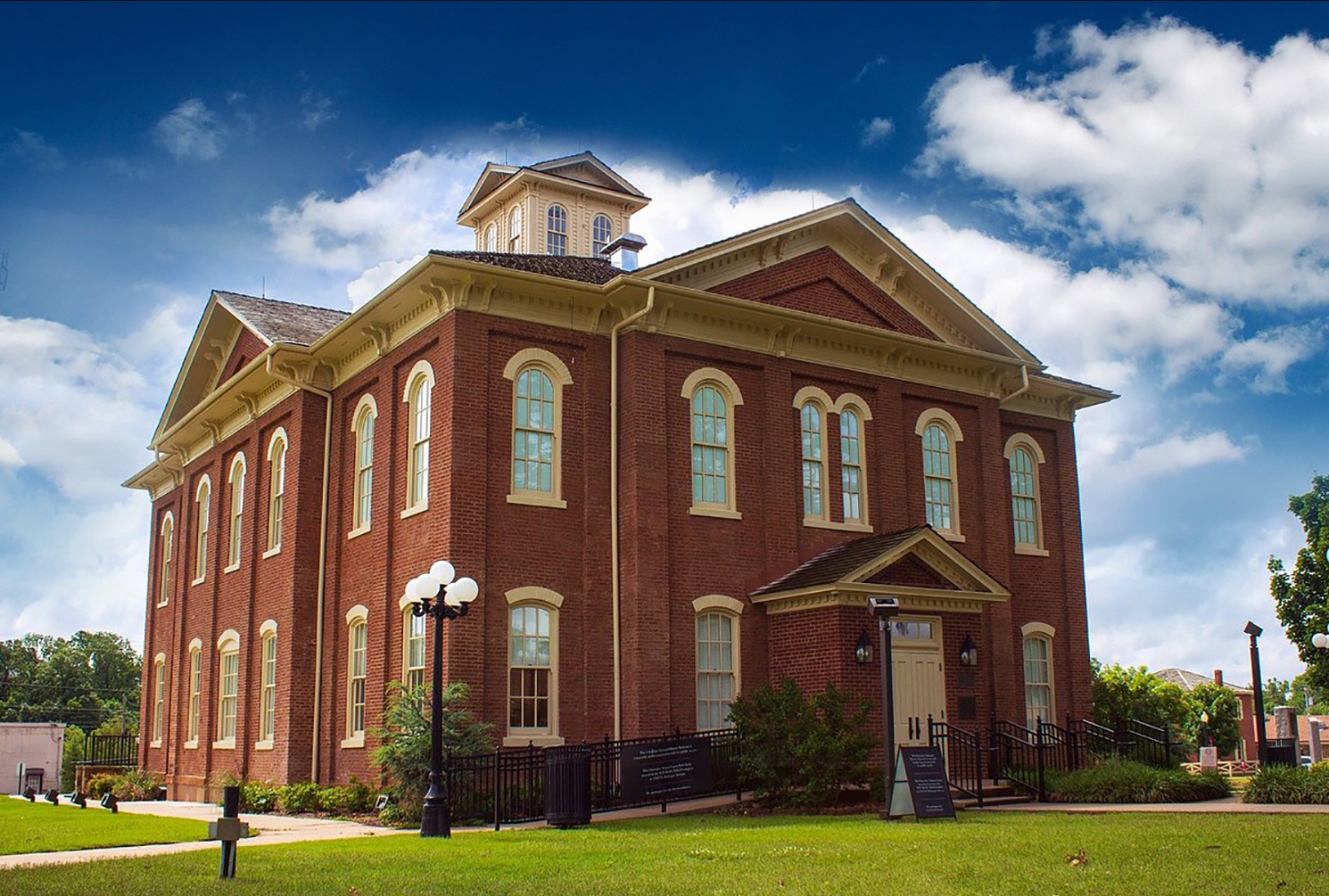
(m1first-fm-abimael-cherokee-2026-courthouse) The Cherokee 1849 Courthouse at Tahlequah, OK
The Cherokee Language
After having been sitting inside a coffee shop in Tahlequah, Oklahoma for several days and working on my computer, while I was taking a pit stop, I noticed a chalk board with some words spelt in both English and Cherokee, as well as the pronunciations of the Cherokee words. After my break, I went up to the counter and asked for some more Kawi. The barista did not understand what I was asking for. Funny, she said that she was Cherokee and did not know any of the Cherokee language.

The Flag of the Cherokee Nation
The Cherokee National Flag was adopted by the Cherokee Nation of Oklahma on 09 October 1978 and was modified by adding a black even pointed star in the upper right corner on 09 September 1989. The flag has an orange field with the Great Seal of the Cherokee Nation at its center and is surrounded by seven yellow seven-pointed stars, all pointing towards the seal. The seven pointed stars represent the seven clans of the Cherokee: Bird, Blue, Deer, Longhair, Paint, Wild Potato, Wolf. These Clans historically defined social structures, marriage rules and community responsibilities.

The Seven Cherokee Clans
Wolf (Aniwaya): The largest clan, known for providing leaders, protectors, and traditionally the war chief.
Long Hair (Anigilohi): Known as peacemakers, this clan often includes spiritual leaders and is associated with adapting to change.
Blue (Anisahoni): Associated with children's health, medicine, and the color blue, they are regarded as one of the oldest clans.
Wild Potato (Anigodagewi): Known as "keepers of the land" and gatherers, they were traditionally responsible for gathering food, specifically the wild potato.
Deer (Aniawi): Associated with hunting and managing relationships with animals, they are recognized for keen senses.
Paint (Aniwodi): Known as traditional healers and makers of ceremonial paint.
Bird (Anitsisqua): Historically associated with messengers.
|
| |
| |
|
To go back to the Gallery Index, click on the down arrow.
|
|
|
Thank you for visiting
The Wayƒarers Journal.
| |
See Ya above the Treeline!
| |
This Page Last Updated: 30 April 2026
|
|
|
|
To continue to the next Episode Level page,
Click here

|
|
| |