|
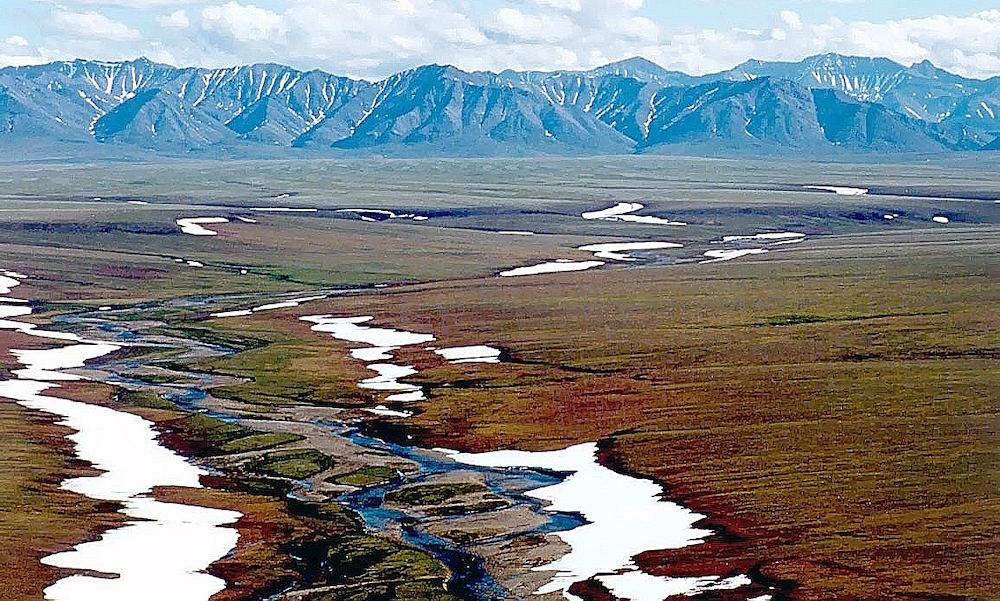
The Arctic Foothills and Lowlands ecoregion is an area that lies north of the Brooks Range and stretches across northern Alaska northward to the Chukchi Sea and all the way eastward across to the border with the Yukon Territory in Canada. The Noatak River valley is the only forested area in this ecoregion.
Arctic Foothills
This ecoregion consists of a wide swath of rolling hills and plateaus that grades from the Arctic Lowlands on the north to the Brooks Range on the south. The east-west extent of the ecoregion stretches from the international boundary between Alaska and the Yukon Territory, Canada, to the Chukchi Sea. The hills and valleys of the region have better defined drainage patterns than those found in the coastal plain to the north and have fewer lakes. The area is underlain by thick permafrost and many ice-related surface features are present. The region is predominantly treeless and is vegetated primarily by mesic graminoid herbaceous communities.
Arctic Lowlands
The northernmost ecoregion in the United States is bounded on the north and the west by the Arctic Ocean and stretches eastward nearly to the international boundary between Alaska and the Yukon Territory, Canada. The poorly drained treeless coastal plain rises very gradually from sea level to the adjacent foothills. The region has an arctic climate, and the entire area is underlain by thick permafrost. Because of poor soil drainage, wet graminoid herbaceous communities are the predominant vegetation cover, and numerous thaw lakes dot the region.
NNN Information:
Description:
Location:
Coordinates:
70.1840016, -151.4349325
Elevation:
0 - 2000 feet
Geographical Region:
Rocky Mountains
The Ancients
First Wayƒarer
First Migration
(The Algonquian Cultures)
After crossing the Beringia land bridge, Joktan and his family began their travel onto this continent, and at times, one of the sons of Joktan would choose to depart from his father to settle at a location or to travel on a different path. This happened when Joktan and his family arrive at what is now called the MacKenzie River and there and then set up camp to overnight. That evening, three of Hazarmaveth′s sons, approached their father to tell him that they have decided to move west back along the north coast of this land towards the land bridge because the fishing and hunting was superb, the forests in the mountainous valleys were abundant and this would be their homeland. Thus, Hazarmaveth told his father Joktan, who made the decision to make camp here along this river and spend time with his grandsons and their families. However, during this camping period, Hazarmaveth approaches Joktan to inform him that he and the rest of his family will also depart the main contingent upon breaking camp, and will move eastward along the northern coast lands into the interior. Soon after that, Hazarmaveth and his family took steps to depart from the rest of the family of Joktan, move eastward around the north side of Machquioen Menuppek (Great Bear Lake).
After the departure of Hazarmaveth and his sons from the camp on the river, then, Joktan and his remaining sons, proceeded upstream along the Mackenzie river. However, soon, Hazarmaveth and his family veered to the east and began walking a separate path around the north side of Machquioen Menuppek (Great Bear Lake). However, Joktan and the rest of his sons continue to move up the MacKenzie River around Machquioen Menuppek to the south west.
The Earth
The Modern Man
The Steps
Steps Afoot
Alaska Footpath Journey Index
Steps Afield
Alaska Roadpath Journey Index
The Appendixes
|