The Wayƒarers Journal ©

The Journal

The Wayƒarers

The Selƒ

The Journey

The Burden

The Mountain

   The Ancients
   The Earth

     Geochronology
     Continents

       Africa
       Antarctica
       Asia
       Europe
       North America

         Geographical

           Arctic Mtns
           Greenland Isl
           CAN Lowlands
           CAN Shield
           Int. Lowlands
           Rocky Mtns
           Basin-Range
           Pacific Coast
           Great Plains
           Appalachian
           Int. Highland
           Coastal Plains
           N. Sierra Mad.
           Volcanic Mtns
           S. Sierra Mad.
           S. M. de Chipas
           S. Pacific Cst
           Island Lands
           Continent Shelf

         Geological

       Oceania
       South America

     Oceans

   The Life
   The Modern Man
   The Nonpareils
   The Steps
   The Way

The Appendix

The Wayƒarer
The Mountain
Go to bottom of this page
THE CAVES
The Lewis and Clark Caverns

The Lewis and Clark Caverns, Montana Go Down Go Back
General Information:
Lewis and Clark Caverns State Park is a 3,000 acre state recreation and nature preservation area which includes two visitor centers, ten miles of hiking trails, a campground, and a limestone caverns with tours.
Once a National Monument, the Caverns was removed from national monument status in 1937 because of not have the required national significance and thereafter became a state park.

Bats
A one time, there were hundreds of western big-eared bats in the caverns, however, now, there are only about 100 females that roost inside the caverns each year to have their pups. Male bats are believed to live in nearby caves. These bats eat thousands of insects every day.
Bats have opposable thumbs and are the only mammals capable of flight. Bat week in August continues annually at the park, with bat programs offered each day during that time.
During World War II, Bat guano was collected by the Civilian Conservation Corps and used to make TNT.

Directions:
The Lewis and Clark Caverns state park can be accessed by taking exit 256 from either direction of IH 90, then turning south on SH 359, to the south side of the interstate highway and the east (not on the interstate entrance road) but to the junction of SH 2. At this junction, turn east and within 1/4 miles drive past a gas station and continues east until the state highway turns in a southern direction. At three miles along SH 2, you will come alongside the Jefferson River and continue along this river until arriving at the state park entrance on the left at just under seven and one half miles.

Middle Rockies Ecoregion
Coordinates:
Park Entrance: 45.821721, -111.851928
Cave Visitors center: 45.838662, -111.867250, Elevation: 5,305 feet
Caverns Entrance: 45.836517, -111.8778063, Elevation: 5584 feet
Caverns Exit: 45.836549, -111.876441, Elevation: 5,307 feet

The 2009 Journey, Lewis and Clark Caverns Go Down Go Up
Above Ground World
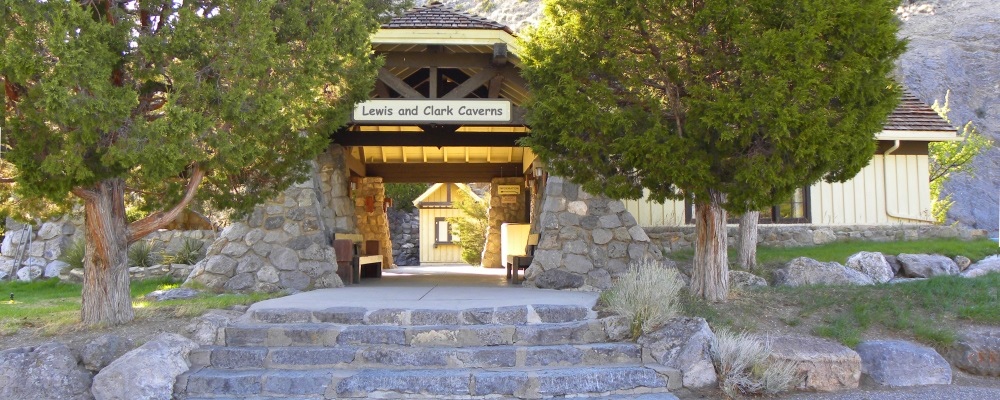
The Visitor Center at
Lewis & Clark Caverns
(m2cont-nam-geog-06-mt-6g-lewisclark-2009-0520.1840) Visitor Center at Lewis and Clark Caverns
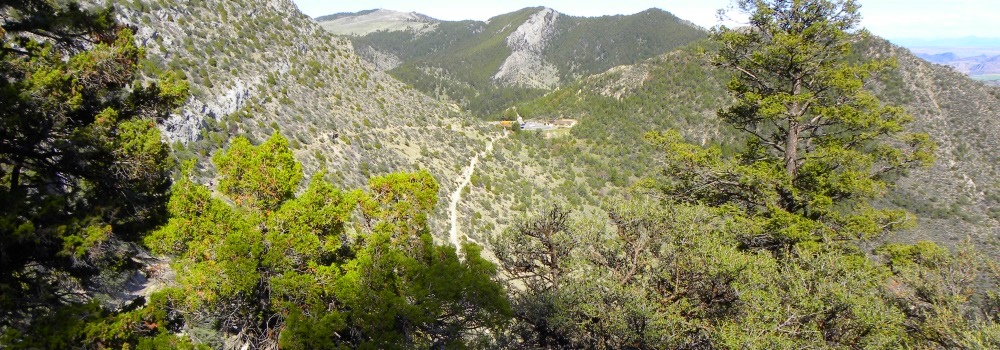
Leaving from the visitors center, we begin a long climb up to the cavern.
The Entrance to
Lewis & Clark Caverns
Little did I know before I arrived that there would be this long of a climb to the actual entrance. Yes, those building in the distance at the bottom of the footpath is where the visitor center is located.

Below Ground World
The climb up took over a half of an hour, but then, we went right into the entrance.

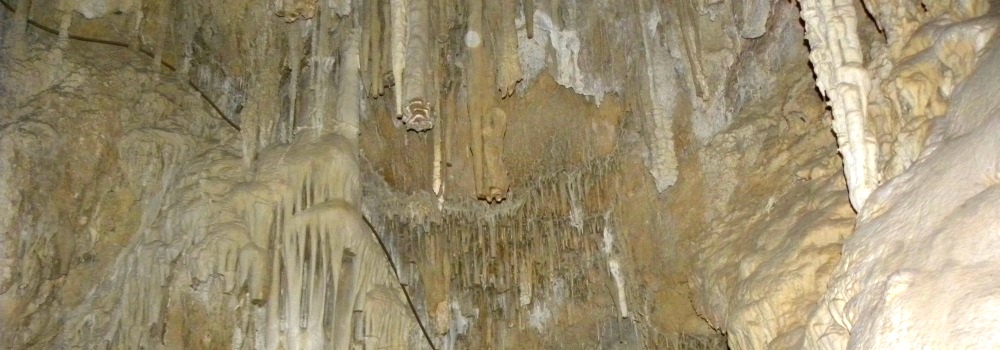
Stalagmites
Stalagmites are formed slowly by a constant drip of mineral laden water dropping from the ceiling and hitting the floor. At the point where the water hits the floor, the water leaves the minerals behind to add to the creation of the stalagmite while the water flows away. This process of growing the stalagmite occurs at a rate of about one inch per year.
The oil from the touch of a person′s hand can stunt the growth of a stalagmite by one hundred year, so don′s touch.
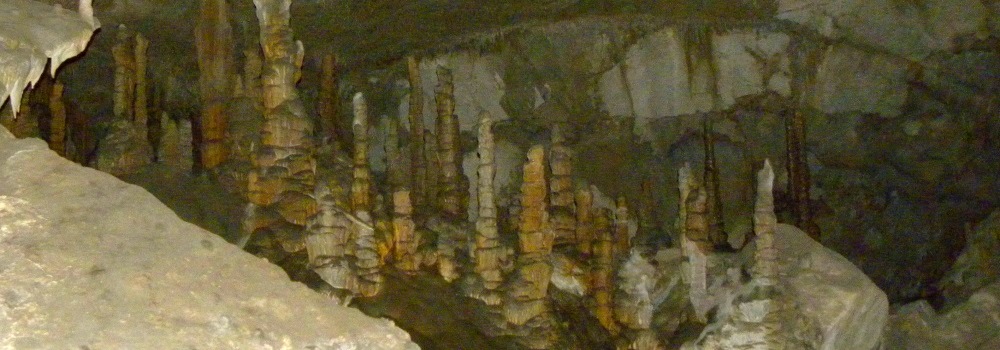
Stalagmites 
Lewis & Clark
(m2cont-nam-geog-06-mt-6g-lewisclark-2009-0520.1726) Stalagmites grow up with all there might
Those formations that grow down from the ceiling are called stalactites and when it meets with a stalagmite, the combined formation becomes a column.

Flow stone
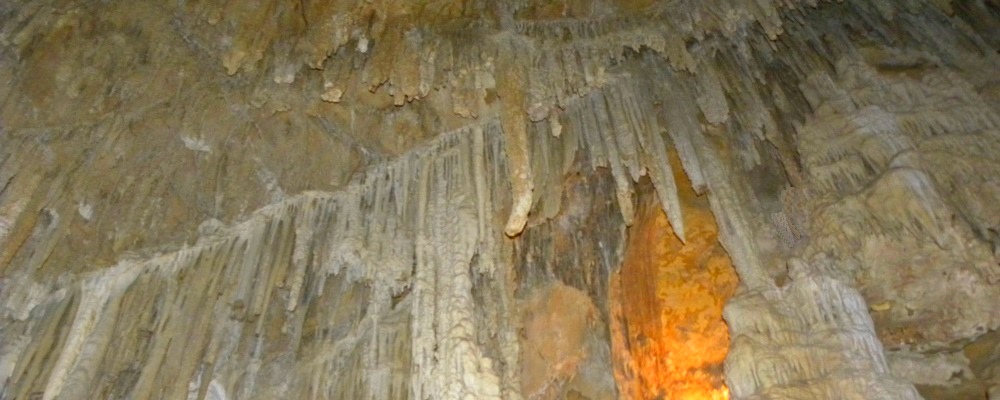
When the amount of water coming from the ceiling is more than a drip, then the formation resulting is called a flowstone.
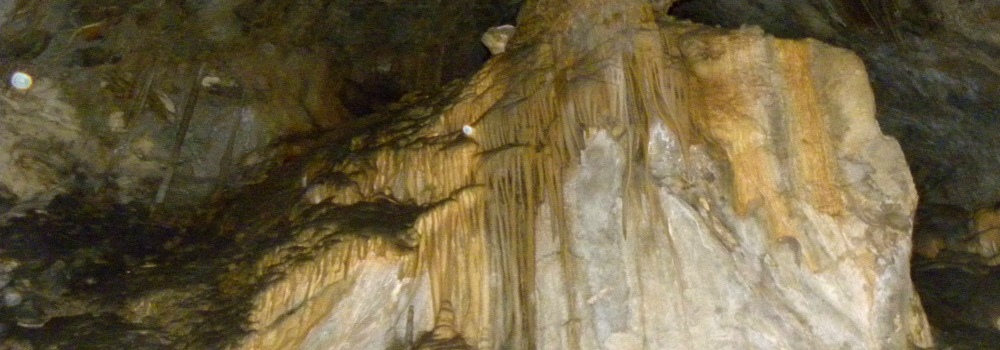
Flowstones at
Lewis & Clark Flowstones at
Lewis & Clark
(m2cont-nam-geog-06-mt-6g-lewisclark-2009-0520.1748) Drapery flowstone beginning over a orange-lit cave.
Flowstone can take on a variety of shapes, sometimes the formation is like a large round boulder, sometimes it will form a thin sheet of opaque stone which are called draperies.

Fried Eggs
Also, the colors that are deposited on the resulting formation can vary greatly, from different shades of brown, red, yellow to almost pure white. This is evident in the stalagmite and flowstone photos above, but there is another type of formation called fried eggs.
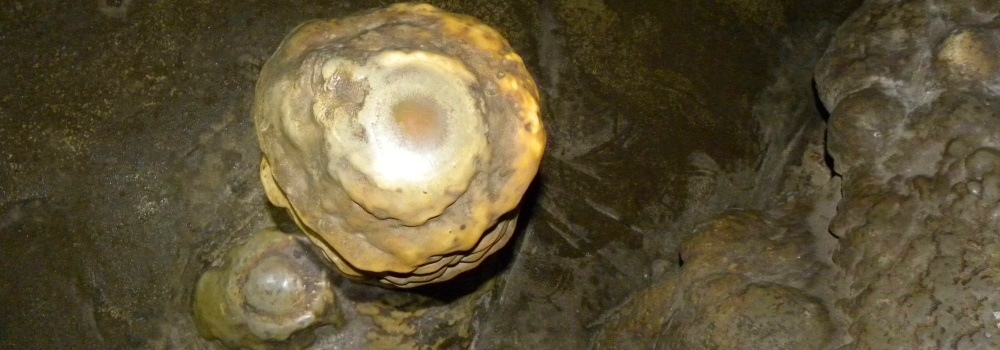
Fried Egg at
Lewis & Clark
Fried eggs occur when a stalagmite begins it′s growth up from the cave floor during which the colors change as it grows giving it the appearance of a fried egg. This color combination is not common but can occur in almost any cave.

Crystals
Another somewhat rare formation are crystals. In this photo, the crystals appear in the middle to the left and look almost clear.
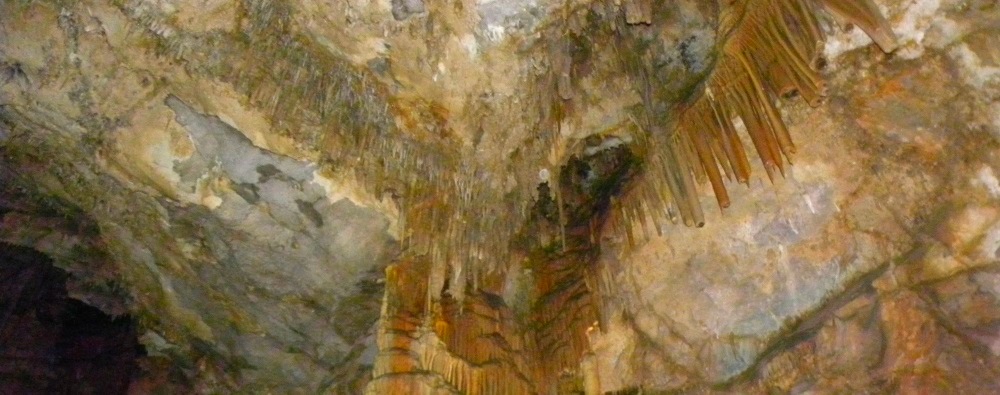
Crystals & Flowstones at
Lewis & Clark
(m2cont-nam-geog-06-mt-6g-lewisclark-2009-0520.1814) Crystals and flowstone at Lewis and Clark.
Crystals can vary quite a bit also, there was one in Virginia I saw that looked like a butterfly.
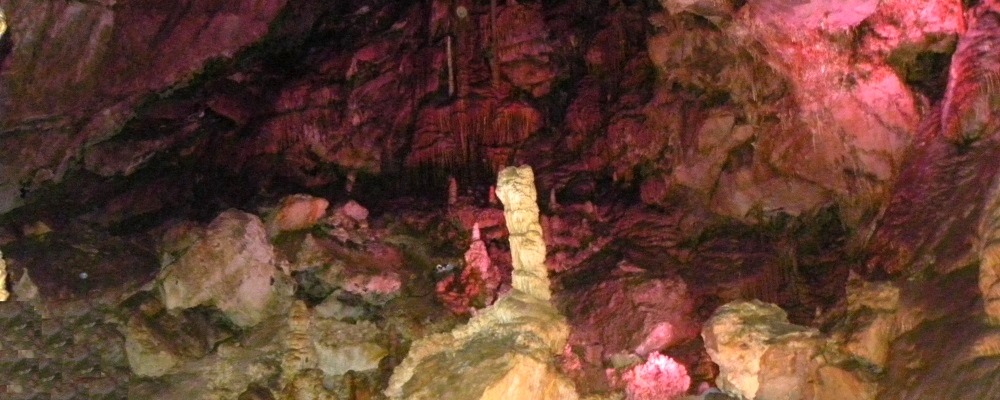
The Colors at
Lewis & Clark
(m2cont-nam-geog-06-mt-6g-lewisclark-2009-0506.1815) Amazing color display at Lewis & Clark

To go back to the Gallery Index, click on down arrow. Go Back Go to previous section
on this page

Thank you for visiting The Wayƒarers Journal.

See Ya above the Treeline!

This Page Last Updated: 31 March 2026


To continue to the next Episode Level page, Click here go to top
 
The Wayƒarers Journal © ::: Come Join the Journey ™
by Thom Buras
Come Join the Journey ™