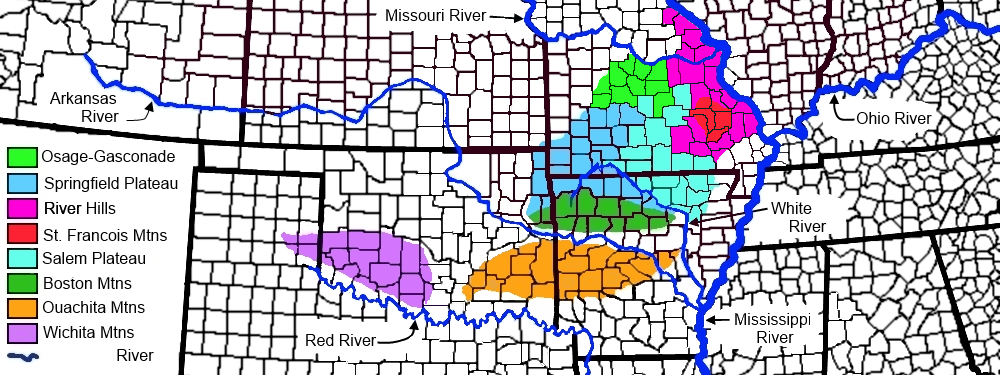
(m2cont-nam-maps-image) The Ouachita Mountains Ecoregion
The Ouachita Mountains
The Ouachita Mountains, commonly referred to as the Ouachitas, are a interior highland region with several mountain range that span across the area of two states, Arkansas and Oklahoma.
The Ouachitas continue in the subsurface to the northeast where they make a poorly understood connection with the Appalachians and to the southwest where they join with the Marathon uplift area of West Texas.
The highest point in the Ouachita Mountains is in Arkansas at Mount Magazine rising to 2,753 feet (839 m) above sea level.
Kiamichi River, Oklahoma
In the valley just to the south of the Talimena Scenic Byway are the remains of a farming settlement of the Caddo people. Found at the sight are depressions in the ground charcoal from fires, middens, stone hoes, pottery fragments and other items. It is believed that by 500 CE, these indigenous people began farming and storing food and soon after, this settlement grew to expand to about four acres in size. The Caddos built villages, became accomplished farmers and began early commerce by trading with others in the surrounding areas.
The specialty of the Kiamichi River settlement was bows made from the Osage orange trees, black tanned doeskins, salt and even some of their agricultural procucts.
Early in the 1800s, the Lenox mission, a small log structure, was established in the Kiamichi valley to serve as a both school and a church. Like many missionaries, Doctor Hobbs was both a minister and a medical doctor. When yellow fever struck the community, Dr. Hobbs and his wife were among the victims and the after their death in 1884, the Mission closed.
By the late 1800s, those indigenous people of this settlement were moved into western Oklahoma.
Oklahoma Ouachita Mountains:
Athens Plateau (extreme southeast)
Cossatot, Missouri Mountains,
Cross Mountains, (Whiskey Peak 1670 feet),
Fourche Mountains,
Trap Mountains.
Winding Stair Mountain:
Talimena Scenic Drive
The Ancients
First Migration
(The Algonquian Cultures)
Ouachita
(pronounced "Wah-sha-taw" or "Washita")
The Ouachita indigenous people were descendants of the
Sons of Diklah are believed to be closely affiliated with the
Caddoan Culture which are one of the several tribes who hunted the Ouachita mountains of ancient Arkansas and Oklahoma between both the
Red river and the Ouichita River. (See the
Mississippi River Map)
In addition to the Ouachita indigenous people, the broader Ouachita River valley area was home to or inhabited by:
Caddo (like the Ouachita, sons of Diklah),
Osage, Son of Dhegiha, of the Southeastern Interior Siouan tribes
Tensas of the Eastern Muskogean tribes,
Chickasaw and Choctaw of the Western Muskogean tribes.
History
The Ouachita indigenous tribe lived in Arkansas along Ouachita River from about 1000 CE to 1700 CE where the hunted the Ouachita Mountains of ancient lands now known as Arkansas and Olahoma.
Some time earlier, their traditional homelands were the lower reaches of the Ouachita River in present-day northeastern Louisiana and along the Red-Black-Ouachita River system, but, the tribe is believed to have moved from there north into Arkansas to the Ouachita river on the northern side of the mountains.
The descendants of the Ouachita are enrolled in the Caddo Nation of Oklahoma
The Earth
Forests and Wilderness Lands:
Ouachita National Forest
Ouachita Mountains
(Between the Red and Arkansas Rivers)
Boston Mountains
(North of the Arkansas River)
Emerald Vista
(34.7158839, -94.6744465)
Wister Lake
Arkansaas River
Kiamichi River
Litle River
Pipe Springs Picnic Area, US 259
(34.6982449, -94.6450152)
The Modern Man
The Steps
Steps Afoot
Ouachita National Recration Trail
Steps Afield
Mountain Gate State Scenic Byway
Mountain Pass State Scenic Byway
|