|
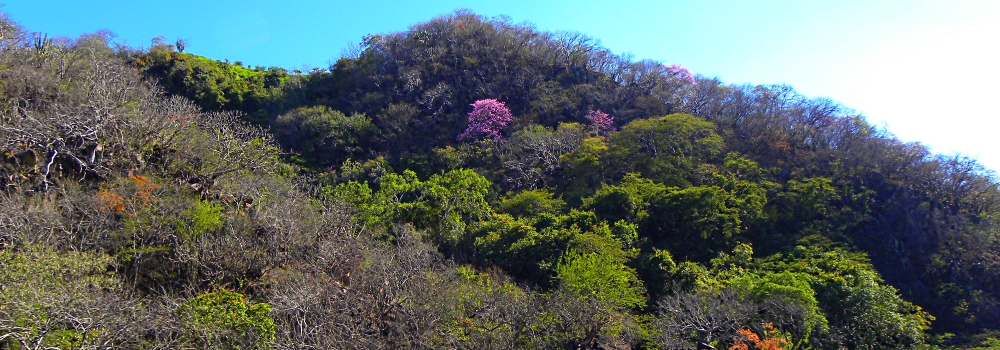
Sierras de Michoacan Ecoregion
Michoacan
Michoacán, Mexico, located on the southwest Pacific coast, is a mountainous state, with nearly to two-thirds of its land area covered by two major mountain ranges: the Sierra Madre del Sur and the Trans-Mexican Volcanic (Neovolcanic Axis).
The Sierra Madre del Sur extends into southern Michoacán, and the Trans-Mexican Volcanic Belt traverses the state. The highest peak in Michoacán is Volcán Tancítaro, reaching 12,615 feet (3,845 meters).
The state of Michoacán, is bordered on the west and up the Pacifice coast is Colima, on the northwest by Jalisco. To the north is Guanajuato, to the northeast is Querétaro, and to the east is the state of Mixico. Finally, to the southeast and directly down the Pacific Coast is Guerrero.
Sierras Information:
Description:
Sierra Madre del Sur
The Sierra Madre del Sur is a mountain range in southern Mexico along 620 miles (1,000 kilometres) of the south Pacific Coast, extending from southwest Michoacán east through Guerrero, to the Isthmus of Tehuantepec in eastern Oaxaca.
The mountains' highest point is Cerro Nube – 3,720 metres (12,200 ft), in southern Oaxaca. Just one major highway crossed the range between Acapulco and Mexico City until 2024, when two major highways, both in the state of Oaxaca, were inaugurated.
The Sierra Madre del Sur is separated from most of the Trans-Mexican Volcanic Belt (Eje Volcánico Transversal) as they both traverse from west to east across the Mexican of central Mexico in northern Oaxaca, but is separated from this range further west by the valley of the Balsas River and its tributary the Tepalcatepec River.
To the north of this range is the Trans-Mexican Volcanic Mountain Range which also extends eastward from the Pacific Coast towards the Mexican east coast but remain separated by the Balsas River valley throughout all of the western areas, but these two mountain ranges are geographically connected in the easternmost regions.
Trans-Mexican Volcanic Mountain Range
The Trans-Mexican Volcanic Mountain Range, (Spanish: Eje Volcánico Transversal), also known as the Transvolcanic Belt and locally as the Sierra Nevada (Snowy Mountain Range), is an active volcanic belt that covers central-southern Mexico. Several of its highest peaks have snow all year long, and during clear weather, they are visible to a large percentage of those who live on the many high plateaus from which these volcanoes rise.
The Trans-Mexican Volcanic Mountain Range spans across central-southern Mexico from the Pacific Ocean to the Gulf of Mexico between the 18° north latitude and 21° north latitude, and this mountain ranges rests upon the southern edge of the North American continental plate. This approximately 600 mile long (1000 kilometer) by 60 to 150 mile wide (90–230 km) geological structure is an active volcanic, east–west, continental arc; which encompasses an area of approximately 62,000 square miles (160,000 km2).
Location:
Coordinates:
19.7074266, -101.1991309
Elevation:
6,221 feet
The Ancients
First Migration
(The Algonquian Cultures)
Second Migration
(The Uto-Aztecan Cultures)
Purépecha of the Tarascan speaking people.
Today, the state of Michoacán is home to a sizable population of Purépecha people,
as well as a minor populations of the
The Earth
Deserts, Basins and Xeric Lands:
Zicuirán-Infiernillo Biosphere Reserve
(18.8467799, -102.0042644)
The Modern Man
The Steps
|