|
The South Dakota Parks
Custer State Park / Black Hills National Forest
The Custer State Park is both a state park and wildlife reserve in the Black Hills. This state park is located in Custer County in the state of South Dakota and is this state′s first state park and the state′s largest. Custer state park is named after Lieutenant Colonel George Armstrong Custer.
This park covers an area of 110.94 square miles, (71,000 acres) of a variety of terrain including rolling prairie grasslands as well as rugged mountains.
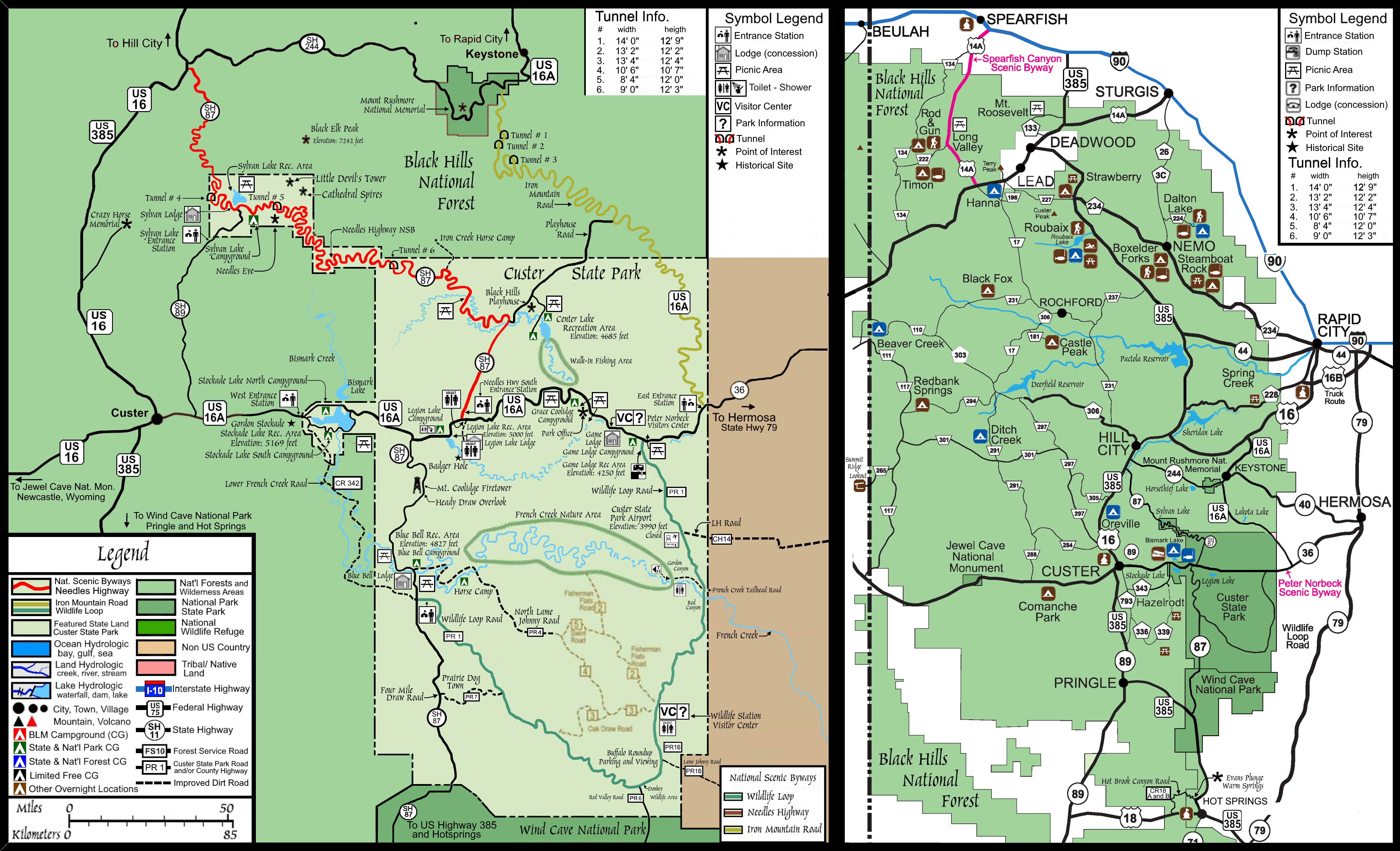
(m0maps-2026-blackhills-map) Custer State Park and Black Hills NF Map
Park Features:
The Custer state park is home to a herd of 1,400 bison. Also, there are elk, coyotes, bob cats, mule deer, white tailed deer, mountain goats, prairie dogs, bighorn sheep, river otters, pronghorn, cougars, and feral burros which inhabit the state park. The state park is known for its scenery, hiking (which includes the South Dakota Centennial Trail), its scenic drives, which include: Iron Mountain Highway, Needles Highway and the Wildlife Loop, with views of the bison herd and prairie dog towns.
The Custer state park is easily accessible by road from Rapid City. Other nearby attractions are Wind Cave National Park, Mount Rushmore, Jewel Cave National Monument, the Crazy Horse Memorial, and Badlands National Park.
History:
This part of the Black Hills originally began as sixteen separate parks, but was later changed into one combined area of land because of the difficulties due to the immense variations of the terrain. Then, in the 1920s, the park began to grow rapidly and by acquiring additional new land areas.
Then, during the era of the Civilian Conservation Corps in the 1930s, the corps built many miles of roads, laid out parks and campgrounds, and built three dams that set up a future of water recreation at the park.
Finally, in 1964 an additional 36 square miles (22,900 acres) were added to the park.
The Bison Herd:
During 1914, the state of South Dakota purchased thirty-six bison in order to begin a bison herd, which was one of the earliest public efforts to preserve the species and that small start thrived in the Black Hills. Over the following decades, Custers bison population grew so successfully that the park had to develop a management system to keep the herd healthy and prevent overgrazing on the native grasses.
By the early 1940′s, the herd had grown up to as many as 2,500 bison. The biggest contribution Custer State Park made was not simply keeping bison alive, but distributing healthy animals to strengthen other herds. Surplus bison from Custer were sold or transferred to ranchers, parks, and conservation programs around the country. Those animals became the foundation for many modern bison herds across the USA.
The park has an annual bison roundup as 400 to 500 calves are born each year, which official Bison roundup started in 1965, even though although Custer State Park has been conducting a round up since the herd began in 1914. Each fall, cowboys and cowgirls gather the herd to evaluate animal health, vaccinate calves, collect data, and select animals for removal so the herd remains balanced with the available grassland. Now there is a yearly auction in September, several hundred are sold at auction so that the remaining number of animals will be compatible with the rangeland forage.
The annual roundups now has a growing crowd of viewers frome 16,000 to 20,000 people. South Dakota Governor Kristi Noem, a horseback rider, has taken part in the roundup which involves 50 to 60 riders herding the animals over a five-mile (8.0 km) trail. The examinations includes gathering biological information such as height, weight, pregnancy checks and the calves are branded and vaccinated. Their genetics can be used to improve the health of other herds.
Geographical Region:
Rocky Mountains
The Ancients
First Migration
(The Algonquian Cultures)
The Earth
The Modern Man
The Steps
|