|
Montanna: Earthquake Lake
If you drive west of Yellowstone National Park along the Madison River, the route will take you first west on US 191, then north from the town of West Yellowstone to where the river crosses under the highway and continues to the west. In order to continue along this river, there is need to turn west onto US 287 and you drive first along the shore of Hebgen Lake and past several communities each of which consist of many rental cabins. At the northwest end of the lake is a concrete and earthen embankment dam, built in 1914 across the Madison River. Continuing west on US 287, the river makes a bend to the southwest and then comes upon the shore of what is now called Earthquake Lake. Why is this lake called Earthquake Lake? Further, what is the story about what happened to give it this name?
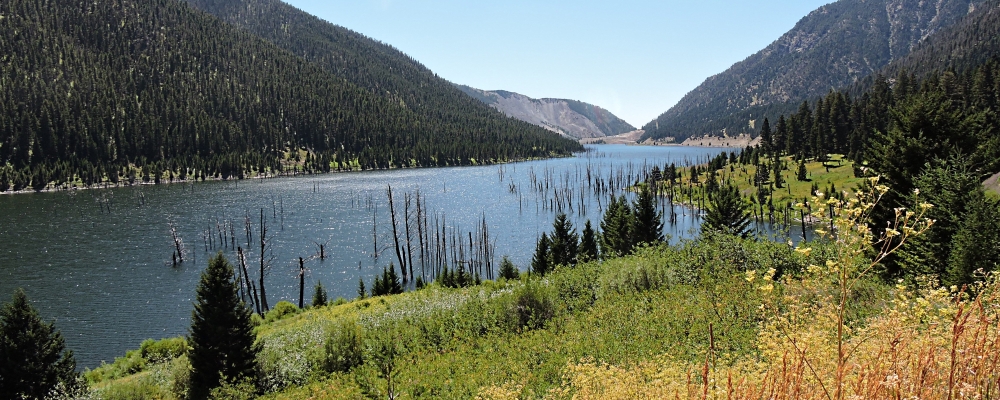
Today, if you come upon this lake in the early morning along, when the mist rises from the water, there can be seen a location along the Madison River with the skeletal trees looming upward from Earthquake Lake which give the feeling of something strangely eerie, and unless a person actually stops to read the information on the several kiosks, would never learn about the unnatural world below just below the surface here. Yes, these several kiosks, tell about how, now, just a few feet below the surface, there are scattered relics along the lake bottom which tell a story of a night of terror and loss.
Too, if this lake bottom was explored, what one may find under the water are picnic tables, crushed cars, camping gear, fishing rods, sleeping bags, tents, even bodies, all left behind, abandoned during a few tragic hours in the middle of the night during the summer camping season on that fateful night in August 1959.
The 1959 Yellowstone Earthquake
Just a short ways north of West Yellowstone, Montana, on August 17, 1959 an earthquake in the Madison River Canyon Area formed Earthquake Lake. That earthquake created a massive landslide of about 80 million tons of rock, which stopped the flow of the Madison River in the Madison River Canyon gorge by creating a massive rock dam.
About the same time, rangers in Yellowstone had been noticing that several geysers in the northwestern sections in
Yellowstone National Park were abnormally erupting and numerous hot springs became temporarily muddied.
In Yellowstone, the day after the earthquake, at least 289 springs in the geyser basins of the Firehow River had erupted as geysers, of which 160 were springs with no previous record of eruption. Many other springs became turbid and new hot ground soon developed in several places with the formation of new hot springs and geysers in Yellowstone.
Since this earthquake, the eruption period of Old Faithful geyser, which had previously been faithfully erupting once every sixty-one minutes, has changed since that earthquake and now the period between geyser eruptions varies between approximately 60 and 110 minutes and the average time between eruptions is close to 90 minutes.
A New Lake
During that August night in 1959, a rock dam was created by the landslide which immediately caused a brand new lake to begin forming, with a quickly rising surface and churning with muddy water and strewn with broken trees. By the dawn of the next day, the lake had already risen to engulf Rock Creek Campground.
This landslide caused 28 deaths, displaces over 200 campers and buried much of what was once Rock Creek Campground and the surrounding area. Also, the landslide cause massive flooding and about eleven million dollars in damage to the forests and highways in the Madison River Canyon Area.
The Event Leading Up to The Loss
Even though it was a Monday, it was still the middle of summer vacation and the eight sites at Rock Creek Campground filled early in the afternoon on that August 17. By evening, any more who arrived had to settle for the unofficial sites further up the camp road, downriver. The mood was cheerful, it was a beautiful moonlit night.
Then, at 11:37 p.m., the earthquake began.
Some of the camper though it was marauding bears, but when they got up to look outside, they realized something bigger was happening. Trees were swaying, many of them cracked, rocks were moving and loose boulders began to bounce down from higher up in the canyon. Then, only minutes later, there came a loud roar.
For the late comers, the ones who took up a camping spot downriver of Rock Creek Campground, it was the last thing they heard as millions of tons of rocks and debris smashed across their campsites. Upstream, in the eight campground sites, the roar was accompanied by a hurricane like wind and a wall of muddy water sweeping away vehicles, tents and the people in them.
These campers along the Madison River on that August night were savaged by three separate devastating events. First, the largest earthquake ever to occur in the Rocky Mountains, a 7.5 magnitude. Second, shortly after the earthquake, a massive landslide, some 80 million tons of earth, crushed everything in it's path, and third, the rising waters of the Madison river filled the now blocked canyon exit.
Because US 287 had been blocked both upstream near Hebgren Lake and downstream from the landslide where the Madison started to begin flooding, there seemed to be no way out for the survivors of the campground. However, by 1 am, many of the refugees converged on the high point of a small ridge north of the river, a point later to be named Refuge Point, and once there they offered one another companionship while they waited for dawn to break and help from the outside world to come. It did not take long for a massive rescue effort to take place with helicopters and paratroopers.
Around noon on the day after the earthquake, a DC-2 aircraft carrying Forest Service smoke jumpers flew in through the west end of Madison River Canyon. The people on the ground felt relief and gratitude as they watched the unfurling of orange and white parachutes. For the next several days, the smoke jumpers brought rescue gear and hope to the survivers. The smoke jumpers worked with the highway patrol and other rescue operations.
As Earthquake Lake continued to rise and after evacuating the people from Refuge Point and the dam, some rescuers stayed on for search and rescue efforts at the campsites down river in the canyon.
The Lake Continued to Increase in Size
Over the course of a couple weeks, the lake rose about nine feet a day and in just three weeks, the new lake was over six mile long and had rise to a maximum of 190 feet, during which time, the several wooden cabins that had been built along the shore of the Madison River, but had been lifted off of their foundations, were floating upstream as the lake increased in it′s depth and length. The location where they eventually settled is now referred to as Ghost Village.
During the initial three weeks after the earthquake and landslide, there was concern the the lake would breach the rock dam and flood the lower Madison Valley, so a spillway was constructed to provide the Madison river an overflow point.
Later, when the level of the lake water began to subside, these cabins became debris along the tree line, now a mile upriver of the lake.
As of 2020, Earthquake lake is currently one hundred and twenty-four feet deep, five miles long and a quarter mile wide, but not for long. As of 2025, the Earthquake Lake Visitor Center reports that the current lake depth has dropped to 120 feet.
This is due to the fact that the lake water level is gradually dropping because the flow of the Madison river continues to erode through the rock dam. Eventually, as the water continues to rush over the spillway, the Madison river will further erode the opening in the rock dam and the lake will drain completely and the Madison river will resume its original path through the canyon.
Well, that is unless there is another earthquake!
|