The Wayƒarers Journal ©

The Journal

The Wayƒarers

The Selƒ

The Journey

The Burden

The Mountain

   The Ancients
   The Earth
   The Life

     The Animals
     The Archaea
     The Bacteria
     The Chromista
     The Fungi
     The Plants

       Angiosperm
       Bryophyta
       Gymnosperm
       Pteridophyta

     The Protozoa

   The Modern Man
   The Nonpareils
   The Steps
   The Way

The Appendix

The Wayƒarer
The Mountain
Go to bottom of this page
THE CLASS MONOCOTYLEDONA
Order Pandanales

The Order Pandanales Go Down Go Up
Pandanales
The Order Pandanales, the pandans or screw-pines, is an order of flowering plants found in the Phylum Angiosperm and in the Class Monocotyledons. Members of the order have a subtropical distribution and includes trees, shrubs, and vines as well as herbaceous plants. The order consists of 5 families, 36 genera and about 1,610 species.

The Pandanales Taxonomy Go Down Go Up
Taxonomy:
Kingdom: Plantea
Phylum: Angiosperm
Class: Monocotyledon
Order: Pandanales
Family: Cyclanthaceae
12 genera, 230 species
Family: Pandanaceae
5 genera, 982 species
Family: Stemonaceae
4 genera, 37 species
Family: Triuridaceae
5 genera, 55 species
Family: Velloziaceae
5 genera, 306 species

Description:
Pandanales are highly diverse including large arboraceous plants of tropical rainforests and coastal areas, climbing vines and lianas, as well as very small achlorophyllous (mycoheterotrophic) and saprophytic herbaceous forest floor species. This has made it difficult to reliably define synapomorphies, but the loss of trimery distinguishes many of them from other lilioid monocots.
The Pandanales order is distinctive with its highly variable and hardly definable floral morphology, especially the number of stamens and their structure as well as many other characteristics. In some of the members, different interpretations exist regarding the composition and organization of the reproductive structures.
Habitat:
Range:
The order contains members mainly distributed in all the tropical and subtropical regions of the world, both New and Old World (including Africa, South America, Australia and Asia). Also, a species is present in China.


The Pandanales Gallery Go Down Go Up
Class Monocotyledonae
Order Pandanales, Family FFF
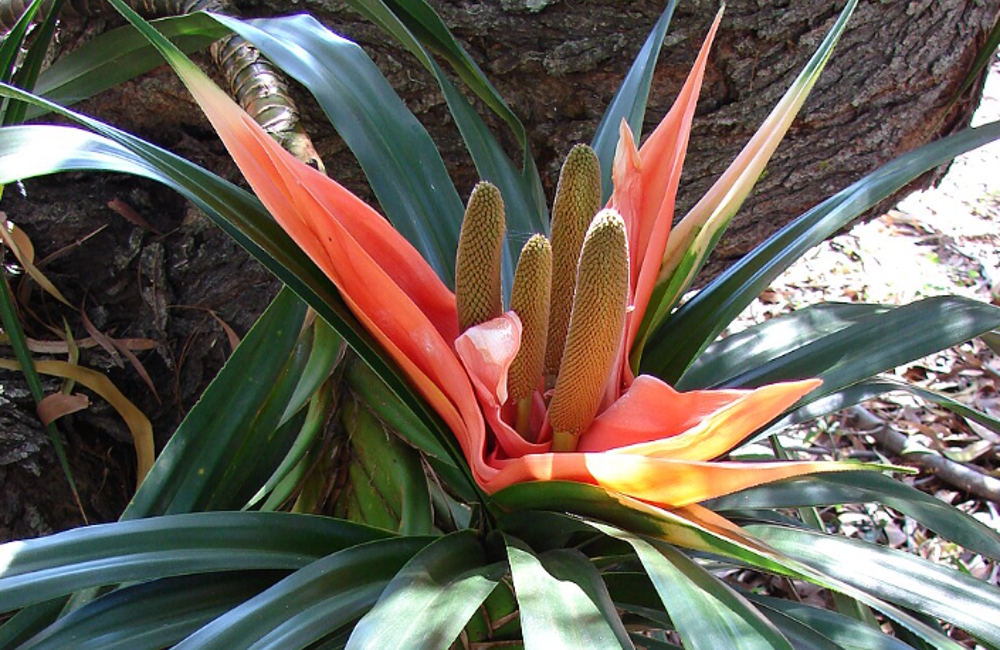
(m3pl-ang-mono-panda-panda) Freycinetia arborea Photo Credit: Wikimedia Commons: Public Domain
Order: Pandanales
Family: Pandanaceae
Genus: Freycinetia
Species: F. arborea
Common Name: ‘ie‘ie
Conservation Status: LC

Description:
Freycinetia arborea, or ‘Ī‘ī, is a densely branched, brittle, woody climber, endemic to the Pacific Islands.
The shiny green leaves have pointed ends and are spiny on the lower side of the midrib and along the edges. Leaves measure 16 to 31 inches (40–80 centimetres) long and 0.4 to 1.2 inches (1–3 centimetres) wide, and are spirally arranged around the ends of branches. Flowers form on spike-like inflorescences at the end of branches, and are either staminate or pistillate. Staminate spikes are yellowish-white and up to 4 iches (10 centimetres) in length. Pistillate spikes are 1.2 to 1.6 inches (3–4 centimetres) but elongate to 3.0 to 3.7 inches (7.5–9.5 centimetres) once fruit are produced. Three to four spikes are surrounded by orange-salmon bracts. Fruit is .4 inches (1 centimetre) long and contains many seeds about .06 inches (1.5-millimetre) in size.
The bracts and fruit of the ‘ie‘ie were a favorite food of the ‘ō‘ū (Psittirostra psittacea), an extinct Hawaiian honeycreeper that was formerly a principal seed dispersal vector for plants with small seeded, fleshy fruits in low elevation forests. It is also a favored food of the ‘alalā (Corvus hawaiiensis), which is currently extinct in the wild.
Habitat:
The ‘ie‘ie is found in moist forests on the Hawaiian, Marquesas, Austral, Society, and Cook Islands. It grows into the forest canopy, attaching itself to a host tree using aerial roots. It may also grow as a sprawling tangle on the forest floor.
Range:
The ‘ie‘ie is endemic to the Pacific Islands.

To Go Back to Class Index, click on the down arrow. Go to previous section
on this page

Thank you for visiting The Wayƒarers Journal.

See Ya above the Treeline!

This Page Last Updated: 30 April 2026


To continue to the next Episode Level page, Click here go to top
 
The Wayƒarers Journal © ::: Come Join the Journey ™
by Thom Buras
Come Join the Journey ™