|
The South Pine Belt Plains ecoregion is a temperate coniferous forest terrestrial area which covers about 54.500 square miles and located in east Texas, northwest Louisiana, southwest Arkansas and a small piece of southeast Oklahoma. Many of the locals refer to this area as the Piney Woods. This ecoregion represents the westernmost portion of the area of the southwestern North America continent which is dominated by pine forest.
Historically, the most dense part of this forested region was called the Big Thicket, however, the lumber industry drastically reduced this area and now the Piney Woods is considered to be one of the critically endangered ecoregions in the US.
The soils and climate in this ecoregion has always been adaptable to the production of a variety of farm crops, including both fruit and vegetable. Like most other areas in these states, cattle raising is widespread, along with the development of pastures planted to improved grasses.
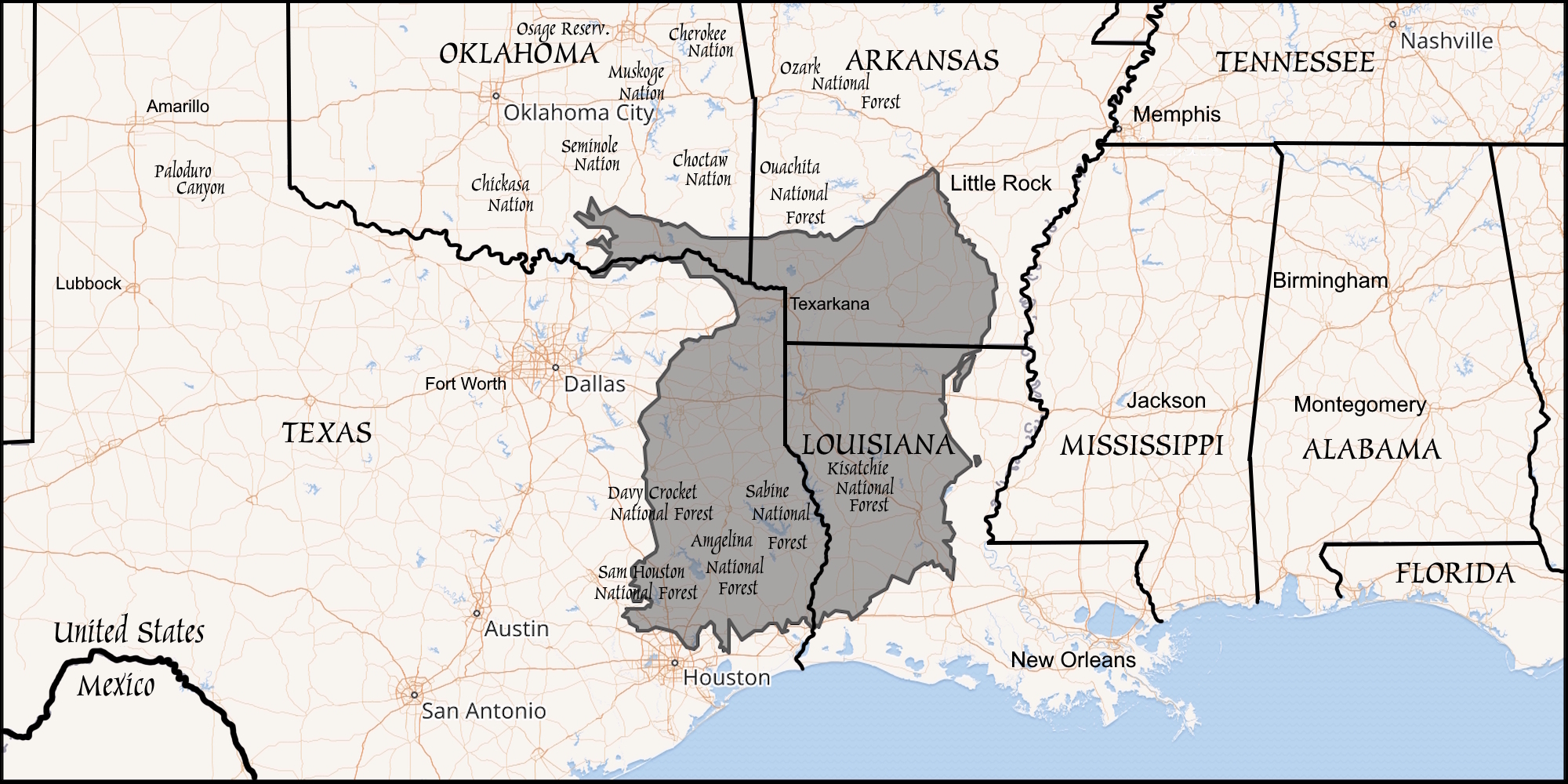
(m0-maps-pineywoods) South Pine Belt Plains Ecoregions
The Louisiana Piney Woods .
The South Pine Belt Plains in Louisiana is a region located in the eastern and northern areas of Louisiana, spanning the area between IH 10 crossing between Houston, Texas and Lake Charles, Louisiana and then northward through Louisiana to the IH 20 as it spans from east of Dallas, Texas to Monroe, Louisiana, and then continuing northward into Arkansas.
The original forest cover was a mix of pine and hardwood forests. However, today, this area is dominated by pine forest, with agriculture, largely located within the floodplain of the Red River.
Much of the forests here now are plantations of loblolly pine (Pinus taeda) and shortleaf pine (Pinus echinata), with the densest forest cover located in the east of this region.
South Pine Belt Plains Information:
Description:
Climate
This ecoregion normally receives from 42 to 52 inches of precipitation annually. The rainfall in this area is considered to be from heavy to moderate and some locations receive over 60 inches per year.
This four state South Pine Belt Plains ecoregion lies towards the warmer end of a humid subtropical climate and the rainfall in the Piney Woods area is much higher than in those regions to the west, however, the Piney Woods rainfall is lower than that rainfall in the
Interior Highlands ecoregions to the north and the
Gulf Coastal Plains ecoregion to the south. The highest rainfall in the South Pine Belt Plains tends to be in the southeast of this ecoregion.
Although much of the year has similar levels of precipitation, August has markedly less, receiving half or less than half of the rainfall occurring during the wettest months, although relative humidity usually remains high through the August dry season. Precipitation peaks in June in parts of the region, in November in others. Summer can see severe thunderstorms, hail, and tornadoes. Winters are mild but can bring some ice, sleet, and on average a month or slightly more worth of freezing temperatures.
Flora
Sandhills are dominated by evergreen trees including longleaf, shortleaf, and loblolly pines. Also found on the sandhills are coniferous trees including bluejack and post oaks. A well-developed understory grows beneath the sparse canopy, and includes yaupon holly and flowering dogwood.
Pine savannas consist of scattered longleaf and loblolly pines alongside black tupelos, sweetgums, and in acid soils along creeks sweetbay magnolias.
Other common trees in this ecoregion include eastern redbud, red maple, southern sugar maple, and American elm. American wisteria, a vine, may cover groves of trees.
Location:
Coordinates:
Elevation:
feet
Geographical Region:
Coastal Plains
The Ancients
First Migration
(The Algonquian Cultures)
Some of the descendants of Joktan′s son Diklah did settle in the Coastal Plains area in Louisiana, Texas and possibly as far south as northern Mexico. Some time earlier, Diklah had departed company from his father and the rest of his other brothers, a time of many farewells and good byes to his brothers, their wives and all of his nieces and nephews. That was a heart rending final camp with Diklah′s extended family. However, the good byes did not stop at that camp. Just a few days later, Diklah was to make camp once again, this time after crossing what is now known as the Mississippi River. There, somewhere along the east side of that great river, Diklah found a good location to make camp with all of his sons and their families, somewhere above the great river′s confluence with what is now known as the Ohio River and it was at this camp that he called all of his sons, their wives and all of Diklah′s grand children to sit at his fire.
It was here at this campfire, and at this location, where he directed his sons, to hunt, to fish and to gather berries and nut, so as to bolstered their food stores. This was because Diklah and his wife had decided to give their final good byes to all of their children and grand children. Yes, this would be a time of a great farewell of all of the family members of Diklah, because when this camp would be broke, all of the Sons of Diklah were to take their families and depart upon their own path ways, yes, they would be leaving to search out each one′s his own homeland.
It was from this camp that the Sons of Diklah together with his their own families would leave their father and mother in order to continue downstream along the Mississippi River and to choose separate paths, either southeast up the Tennessee River, or west back up the Missouri River to the Kansas River and then up that waterway. Some would choose to travel southwest towards the Arkansas River and some would follow the Mississippi river further south. Then of those who go south, some would head east into the coastal lands of the southeast and some would head into the coastal lands to the southwest, all searching for a perfect location where each could make their homeland. Only then would each make camp apart from the rest of their family, settle and begin to raise each their own tribes.
The Earth
Forests and Wilderness Lands:
Kistachie National Forest
The Modern Man
Louisiana Campground Index
The Steps
Steps Afoot
Louisiana Footpath Journey Index
Steps Afield
Louisiana Roadpath Journey Index
South Pine Belt Roadpaths
|