|
California: Klamath River
The Klamath River is a 257-mile (414 km) long river in southern Oregon and northern California. Beginning near the city of Klamath Falls in the Oregon high desert, it flows west through the Cascade Range and Klamath Mountains before reaching the temperate rainforest of California's North Coast, where it empties into the Pacific Ocean.
The Klamath River is the third-largest salmon and steelhead producing river within the west coast of the contiguous United States. The watershed of the Klamath Basin encompasses more than 15,000 square miles (39,000 km2), and is known for its biodiverse forests, large areas of designated wilderness, and freshwater marshes that provide key migratory bird habitat.
According to the wise men of this world, the official source of the Klamath River is within the upper reaches of Lake Ewauna, a small natural lake near Klamath Falls, Oregon. The primary inflow upstream of Lake Ewauna is the short Link River, which connects Lake Ewauna to the Upper Klamath Lake. Upper Klamath, in turn, is fed by the Williamson River (originating in the Winema National Forest) and Wood River (originating in Crater Lake National Park).[14][15] For the first 18 miles (29 km) below Lake Ewauna, the Klamath River t, akes a slow meandering course through what was formerly the Klamath Marshes, which were drained for agriculture in the early 20th century. An artificial channel diverts water from the Lost River, which normally flows into Tule Lake, into the Klamath during periods of high runoff, making the Lost River part of the Klamath River Basin.
Finally, there is one more Modern Man change to the Klamath River Basin, which is the 17.5 feet diameter by 10.7 mile long diversion tunnel known as the Clear Creek Tunnel. This tunnel carries/diverts water from the Trinity River, the largest ributary of the Klamath River basin, southeastward crossing into the Whiskeytown Lake National Recreations Area and d
epositing that water into the Central Valley region of California by releasing the water into the Sacramento River Basin. The process of this water diverting goes through two separate powerhouses, one at each end of the Clear Creek Tunnel, in order to generate power at both ends of that water flow. The Clear Creek Tunnel is part of the Trinity River Division of the Central Valley Project, a system that diverts the water between the two river basins to generate power and ultimately use the water to supply irrigation water to Central Valley agriculture.
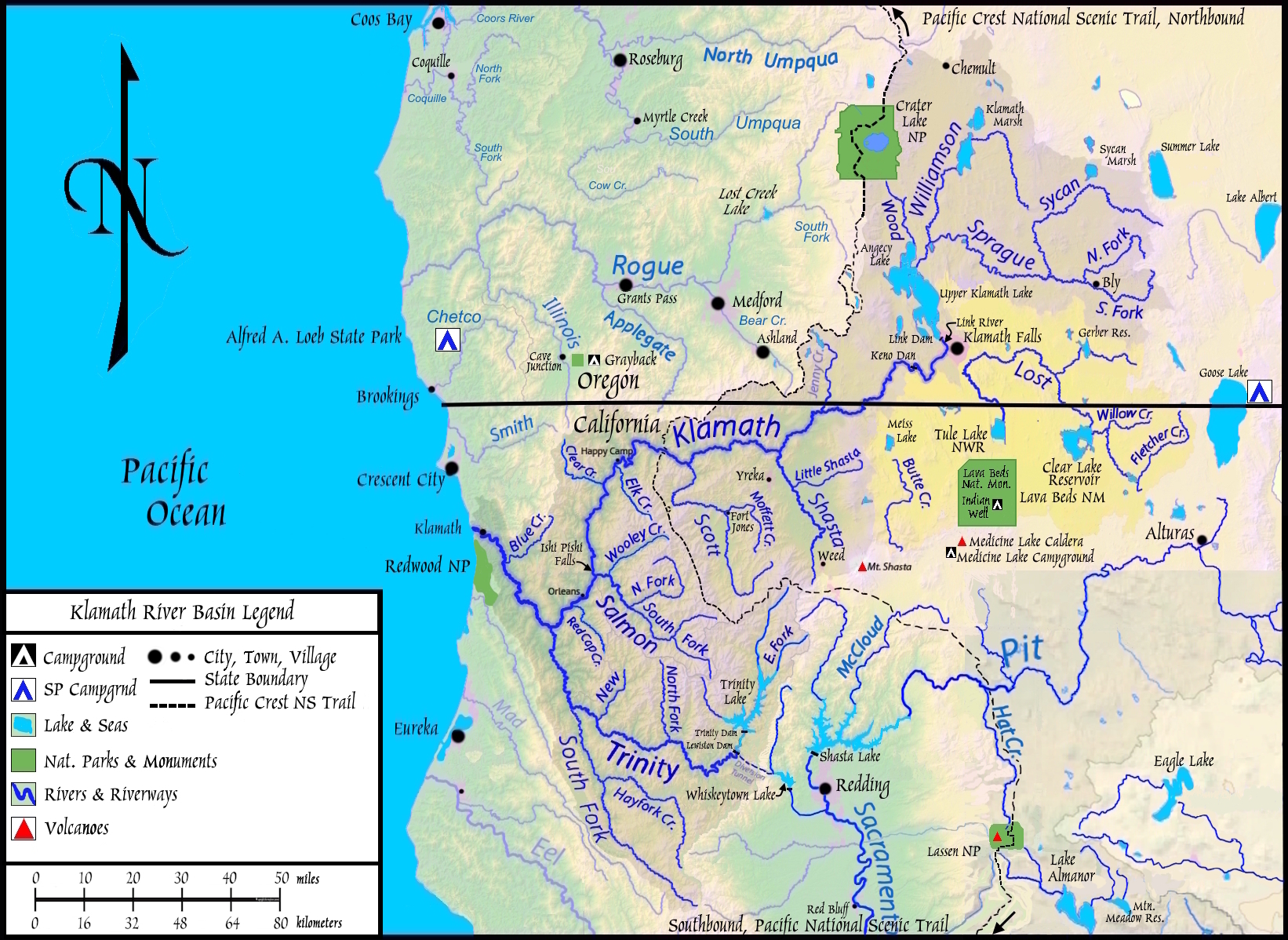
(m0-maps-klamathriver-map) The Klamath River Basin Map
Klamath River Information:
Description:
Location:
Coordinates, Mouth:
41.5424245, -124.0773192
Pacific Ocean
Elevation:
0 feet
Coordinates, Source:
42.1955090, -121.7774023
Lake Ewauna
Elevation:
4.088 feet
Tributaries:
Trinity River
41.1858807, -123.7112104
Salmon River
41.3778741, -123.4930558
Scott River
41.7785011, -123.0367610
Shasta River
41.8309241, -122.5944519
Jenny Creek
41.9760355, -122.3999127
Distributaries:
Link River
42.2195393, -121.7903717
Geographical Information:
Geographical Region:
Pacific Coast
The Ancients
The name Klamath came from the people called the Klamet or of the Klamath Tribe, a word with originally came from the Chinookan word meaning They of the River.
Although most Indigenous people who lived on the banks of the Klamath River depended on the hugh Salmon runs, those of the upper basin in Oregon and the extreme northeast area of California did not depend on Salmon as much as did downstream tribes but were primarily hunter-gatherers.
The many different indigenous tribes who hunted, fished and lived along the Klamath River practiced traditional ecological knowledge that have been gathered by the local indigenous people over the course of hundreds, if not thousands of years of their immersive stewardship of their corner of the natural world. All of this vast resource of acquired knowledge was lost with the invasion of the Spanish colonization of California in the 1780, bringing disease, genocide forced removal, relocations to missions and many of the indigenous children being separated from their families and forced to attend boarding schools which forced them to speak English, dress in Western clothes and eat Western Foods. This led to a generational disconnect and loss of knowledge of many cultural practices.
First Migration
(The Algonquian Cultures)
Of the Algonquian cultures, those who lived along the banks of the Klamath River were the Klamath, Modoc, Yurok and the Yahooskin. Most all of those who inhabited the lands of the Klamath River are highly dependent on the Pacific Salmon runs, who caught the salmon with wiers, basket traps and harpoons.
Second Migration
(The Uto-Aztecan Cultures)
Of the Uto-Aztecan speaking people, the Washoe family group, the Karuk and the Shasta live in the land of the Klamath River.
The Ishi Pishi Falls (41.3820578, -123.4994808) a set of rapids just above the confluence with the Salmon River has been a traditional fishing ground of the Karuk.
Third Migration
(The Athabascan Cultures)
Of the Athabascan speaking people the Hupa family group also found their way to the banks of the Klamath River and the Salmon runs.
The Earth
Volcanoes and Lava Fields:
California Volcanoes & Lava Fields Gallery Index
The Modern Man
California Campground Index
The Steps
Steps Afoot
Pacific Crest National Scenic Trail
Steps Afield
California Roadpath Journey Index
Oregon Roadpath Journey Index
|