
The Wayƒarers Journal ©

The Journal

The Wayƒarers

The Selƒ

The Journey

The Burden

The Mountain

   The Ancients
   The Earth
   The Life

     The Animals

       Annelida
       Arthropoda
       Chordata

         Amphibians
         Birds
         Fish
         Mammals

           Aardvarks
           Armadillos
           Bats
           Carnivores
           Elephants
           Hedgehogs
           Hyraxes
           Manatees
           Marsupial
           Platypus
           Primates
           Rabbits
           Rodents
           Sloths
           Ungulate-Even
           Ungulate-Odd
           Whales

         Reptiles

       Cnidaria
       Echinodermata
       Mollusca
       Nematoda
       Platyhelminthes
       Porifera

     The Archaea
     The Bacteria
     The Chromista
     The Fungi
     The Plants
     The Protozoa

   The Modern Man
   The Nonpareils
   The Steps
   The Way

The Appendix

The Wayƒarer
The Mountain
Go to bottom of this page
THE RODENT FAMILIES
The Family Sciuridae

The Genus Marmota Go Down Go Up
Marmots are large ground squirrels in the genus Marmota, with 15 species living in Asia, Europe, and North America. These herbivores are active during the summer, when they can often be found in groups, but are not seen during the winter, when they hibernate underground.
They are the heaviest members of the squirrel family.

Taxonomy:
Phylum: Chordata
Class: Mammals
Order: Rodentia
Family: Sciuridae
Subfamily: Xerinae
Tribe: Marmotini, Ground Squirrels
Genus: Marmota, Marmots

The Genus Marmota, Marmot Species Go Down Go Up
Genus: Marmota, Marmots
Alaska marmot, (Marmota broweri), (LC), n. AK
alpine marmot, (Marmota marmota), (LC), c. s. EU
black-capped marmots, (Marmota camtschatica), (LC), e. Siberia
Bobak marmot, (Marmota bobak), (LC), e. EU, c. AS
forest-steppe marmot, (Marmota kastschenkoi), (LC), s. RUS
gray marmot, (Marmota baibacina), (LC), c. AS
goundhog, woodchuck (Marmota monax), (LC), n. NA,
Himalayan marmot, (Marmota himalayana), (LC), TIB plateau
long-tailed marmot, (Marmota caudata), (LC), c. AS
Menzbier′s marmot, (Marmota menzbieri), (VU), c, AS
Tarbagan marmot, (Marmota sibirica), (EN), CHN, RUS, MNG
hoary marmot, (Marmota caligata), (LC), nw. NA,
Olympic marmot, (Marmota olympus), (LC), Olympic Peninsula, WA
Vancouver Island marmot, (Marmota vancouvrensis), (CR), BC, CAN
yellow-bellied marmot, (Marmota flaviventris), (LC), w. USA, sw.CAN

The 2020 Journey, Groundhog, Woodchuck Go Down Go Up
Groundhog
Also know as the ground pig, land beaver, whistle pig, whistler, woodchuck, Canada marmot, the siffleux by French Canadians, and the Monax which is from the Algonquian word meaning digger.
Habitat:
The groundhog prefers open country and the edges of woodland with a wide geographic range. It is typically found in low-elevation forests, small woodlots, fields, pastures and hedgerows. It constructs dens in well-drained soil, and most have summer and winter dens. Groundhogs are rarely far from a burrow entrance.
Groundhogs are among the few species of true hibernators, which behavior has led to the North American tradition of Groundhog Day. Normally emerging from their winter burrows in February is the reason for the date of the tradition. The shadow observing has no scientific basis as it was imported from a German tradition on the behavior of the European badger and totally unrelated animal.
Range: Central and Eastern USA, Most of Canada
Except for the boreal ecoregions above 60° northern latitude, they are found in most all of the Interior Lowlands Region and Canadian Shield Region, and some can be found in the Basin and Range areas of both Alaska and British Columbia.
Also, they are found in all of the Appalachian Mountains Region, in the Interior Highlands Region, and in the northernmost areas of the Coastal Plains Region.
The Rodentia
The Yellow-bellied Marmot The Rodentia
The Yellow-bellied Marmot

The 2009 Journey, Yellow-bellied Marmot Go Down Go Up
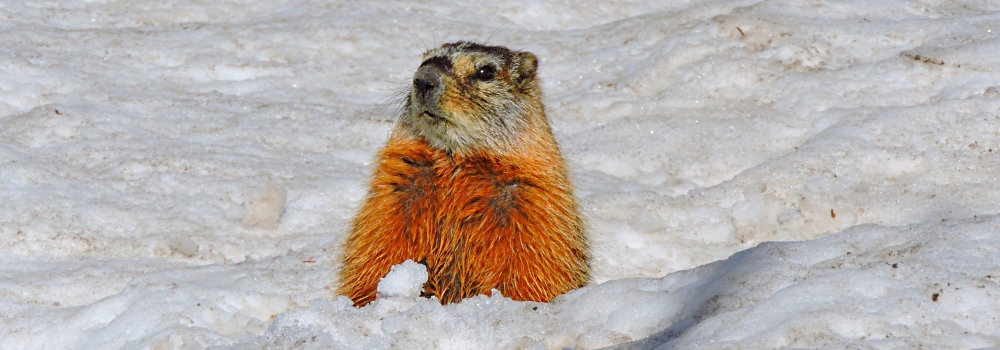
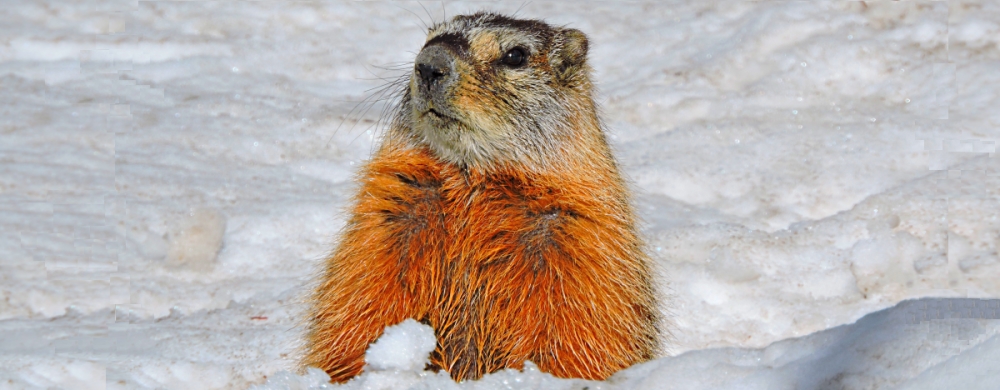
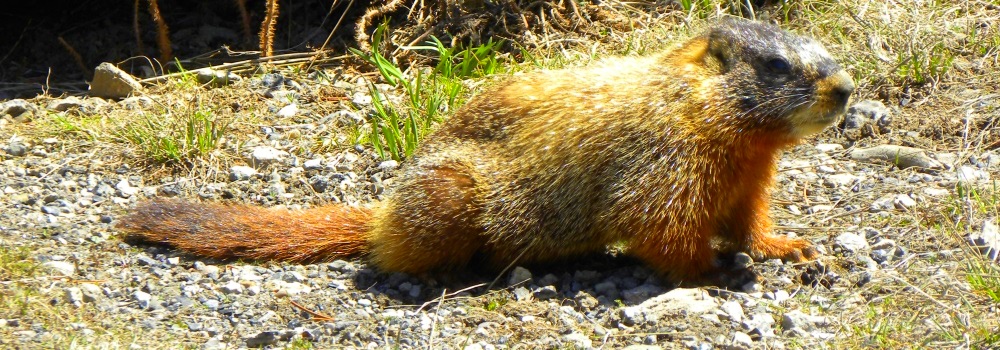
The yellow-bellied marmot is the best studied marmot species. They have a harem-polygnous social system, with a male defending his harem of 1-4 females. Colonies, or groups of harems in the same area, may have 10-20 individuals harems. About ninety percent of yellow-bellied marmots live in this type of social groups.
Adult males are territorial and agonistic towards each other where females are amicable and often jointly raise the young. Each male marmot digs a burrow with several entrances in well-drained soil for his harem. The burrows are about three to four feet deep, with tunnels between 33 to over 200 feet long between the entrances. Hibernation burrows may be 16 to 23 feet deep. These burrows are dug under rocks to so as to camouflage them from predators.
Yellow-bellied Marmot (Marmota flaviventris)
Conservation Status: Least Concern (LC)
Location: Western US, southwestern Canada
Sub-species: Eleven

Friday, 22 May 2009, Yellowstone Park, WY.
(Day 1228 BR) 34°F. 6:00 am
Madison River Campground. Campsite #22 A, CRS: 4.0
Again, I am up very early because of the cold weather, start the engine and turn on the heater. It does not take long for it to warm up and begin exploring the park once again. Later, after it warms up outside, I stop to prepare my breakfast.
After eating, I then pack out of the campground and resume exploring. Not long before noon, I see a marmot emerging from his rock hole and stop to photograph him. He stays close to his hole but seems to be enjoying being out in the sun.
The Rodentia
The Yellow-bellied Marmot The Rodentia
The Yellow-bellied Marmot
And then the yellow-bellied marmot scurried back into his hole. Methought, this is why probably why these rodents are called Sciuridea.

To go back to Rodentia Order Index, click on down arrow. Go Back Go to previous section
on this page

Thank you for visiting The Wayƒarers Journal.

See Ya above the Treeline!

This Page Last Updated: 31 March 2026


To continue to the next Episode Level page, Click here go to top
 
The Wayƒarers Journal © ::: Come Join the Journey ™
by Thom Buras
Come Join the Journey ™