|
Harry Sinclair Lewis was an American novelist, short-story writer, and playwright. In 1930, he became the first author from the United States (and the first from the Americas) to receive the Nobel Prize in Literature, which was awarded "for his vigorous and graphic art of description and his ability to create, with wit and humor, new types of characters." Lewis wrote six popular novels: Main Street (1920), Babbitt (1922), Arrowsmith (1925), Elmer Gantry (1927), Dodsworth (1929), and It Can′t Happen Here (1935).
Several of his notable works were critical of American capitalism and materialism during the inter-war period between the World Wars. Lewis is respected for his strong characterizations of modern working women.
Sinclair Lewis was born on the 7th of February 1885 in the village of Sauk Center, Minnesota, to Edwin Lewis, a physician of Welsh descent, and Emma Kermott Lewis. He had two older siblings, Fred (1875) and Clude (1878).
His father was a stern disciplinarian, who had difficulty relating to his sensitive, unathletic third son. Lewis′s mother died in 1891. The next year Edwin married Isabel Warner, whom young Lewis apparently liked. Lewis began reading books while young, and kept a diary. At the age of 13, he ran away from home and unsuccessfully tried to become a drummer boy in the Spanish–American War.
He entered Yale in 1903, but did not receive his bachelor's degree until 1908, taking time off to work at Helicon Home Colony, Upton Sinclair's cooperative-living colony in Englewood, New Jersey, and to travel to Panama.
Upon moving to Washington, D.C., Lewis devoted himself to writing. As early as 1916, he began taking notes for a realistic novel about small-town life. Work on that novel continued into the first part of 1920, and when he completed Main Street, which was published on October 23, 1920. Lewis'′s agent had the most optimistic projection of sales at 25,000 copies. In its first six months, Main Street sold 180,000 copies, and within a few years, sales were over two million. This success turned Sauk Center into the "Original Home Town" and many businesses took advantage of the free advertisement.
In 1930, Lewis won the Nobel Prize in Literature, the first writer from the United States to receive the award. After winning the Nobel Prize, Lewis wrote eleven more novels, ten of which appeared in his lifetime. The best remembered is It Can't Happen Here (1935), a novel about the election of a fascist to the American presidency.
Now, the town of Sauk Center, Minnesota has created at least two wall murals, as the sun just begins to set on this cold fall day, I photograph two of the murals and a few other items in town.

(m4architec-mn-sinclairlewis-2025-1013.1830) Sunset upon Arriving in Sauk Center

(m4architec-mn-sinclairlewis-2025-1013.1831) Sauk Center, MN Wall Murals
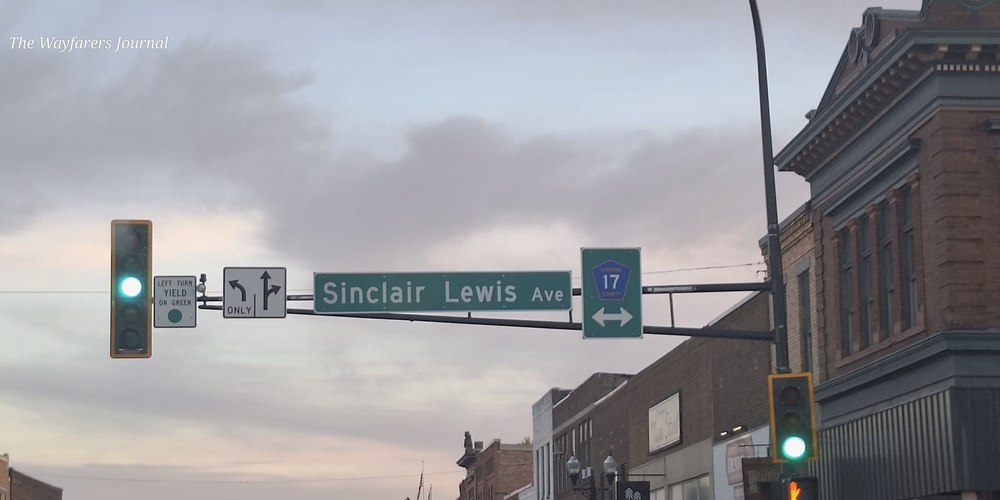
(m4architec-mn-sinclairlewis-2025-1013.1834) Sinclair Lewis Avenue

(m4architec-mn-sinclairlewis-2025-1013.1835) Multiple panel Wall Mural

(m4architec-mn-sinclairlewis-2025-1013.1836) Multiple panel Wall Mural

(m4architec-mn-sinclairlewis-2025-1013.1841) The Original Main Street, USA
|