|
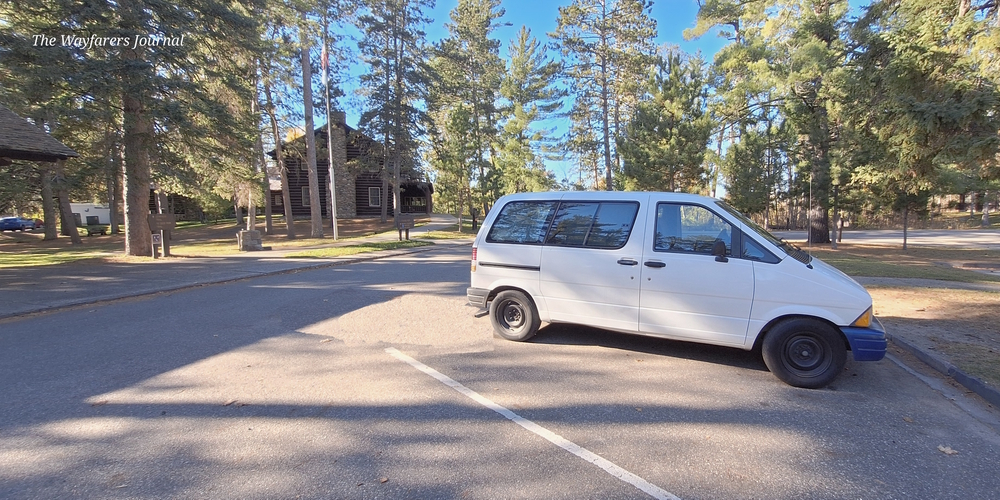
The Douglas Lodge is a Minnesota State Park constructed between 1903 and 1905, and is a historic building which was significant in the early development of the state park. The Itasca area forests during the late 1800s contained towering old growth pines interspersed with numerous lakes. However, many people have long appreciated Lake Itasca′s beauty and resources. There were even a few individuals that recognized that if uncontrolled economic lumbering would completely change the landscape of the state of Minnesota. The efforts of these individuals to preserve Lake Itasca led them to contend with the lumber industry, public interests, and the politics that was interwoven between them.
Indigenous People
Thousand of years ago, indigenous people, while hunting, left spears at a bison kill site in the area. Then, as it is believed, around 1200 CE. the Blackduck people built a village there, and over the centuries, began to leave broken remnants of their unique pottery behind. Ojibwe groups have lived in the vacinity of the lake, at lease from the early 1700s.
Louisiana Purchase
In 1803, the US government purchase the Louisiana Territory from France and the United States began to turn their attention to the area of Minnesota. Then, in 1832, the Ojibwe leader Ozaawindib brought Henry Schoolcraft (28 March 1793-10 December 1864) to Omushkos Lake and the headwaters area of the Mississippi River. Schoolcraft a geographer, geoligist and ethnologist was noted for his early studies of the indigenous people, even serving as an US indian agent for a time. Schoolcraft married Jane Johnston, daughter of a prominent Schoch-Irish fur trader and an Ojibwe mother who was the high-ranking daughter of Waubojeeg, a war chier. Jane was bilingual and educated, having grown up in a literate household. After marrying Schoolcraft, Jane taught her husband the Ojibwe language and much about the indigenous tribe′s culture. Together, Henry and Jane Schoolcraft had children, two of which survived past childhood, and Jane Schoolcraft is now redognized for her poetry and other writtings as the firs Native American literary writer in the United States.
Schoolcraft was elected to the legislature of the Michigan Territory (which included the current states of Michigan, Minnesota, Iowa and the eastern parts of North and South Dakota), where he served from 1828 to 1832. In 1832, he traveled again to the upper reaches of the Mississippi to settle continuing troubles between the Ojibwe and Dakota (Sioux) nations. He worked to talk to as many Native American leaders as possible to maintain the peace. He was also provided with a surgeon and given instructions to begin vaccinating Native Americans against smallpox. He determined that smallpox had been unknown among the Ojibwe before the return in 1750 of a war party that had contact with Europeans on the East Coast.
Henry Schoolcraft continue to study the indigenous people and to publish written works concerning the. By 1846, Jane Schoolcraft had dies, and during that same year, Henry Schoolcraft, was commissioned by the US Congress for a major study, which was known as Indian Tribes of the United States. It was published in six volumes from 1851 to 1857, and had illustrations by Seth Eastman, an Army officer who was an artist of indigenous peoples.
During his continued travels throughout the Michigan Territory, Schoolcraft took the opportunity to explore the region, making the first accurate map of the Lake District around western Lake Superior. Following the lead of Ozawindib, an Ojibwe guide, Schoolcraft encountered the true headwaters of the Mississippi River, a lake that the natives called "Omushkos", which in the Ojibwe language means, "Elk Lake." Schoolcraft then chose to rename the Lake, Lake Itasca, a name which he coined from the Latin words veritas meaning, truth and caput meaning head. Also, the nearby
The nearby Schoolcraft River, the first major tributary of the Mississippi, was later named in his honor. United States newspapers widely covered this expedition. Schoolcraft followed up with a personal account of the discovery with his book, Narrative of an Expedition Through the Upper Mississippi River to Itasca Lake (1834).
Douglas Lodge
The Douglas Lodge is situated on the south shore of Lake Itasca in Itasca State Park, Minnesota. The lodge is seasonal and operates with limited hours in the off season.
The normal operating season from the Friday of Memorial Day weekend through the first Sunday in October. During the peak summer season, the Lodge restaurant offers extensive dining opportunities, including breakfast, lunch and dinner. During October 2025, there is a buffet lunch on Thursday, Friday, Saturday and Sundays from 11 am to 5 pm through the 19th of October.
Douglas Lodge Information:
Year Open:
1905
Architect:
Clarence H. Johnston
Type Construction:
Rustic Style Architecture with natural materials
Location:
Coordinates:
47.1916786, -95.1705438
Elevation:
1,515 feet
Address:
Itasca State Park, Dogulas Lodge Drive, Lake Itasca, MN 56470-9722
Entrance Fee:
Access, Military, Senior pass holders enter free
|