|
El Camino Real de los Tejas:
A 2500 mile Roadpath Journey
The historic trail known as El Camino Real de Los Tejas was traveled from the capitol of New Spain, which is now referred to as Mexico City, north through a mountain passage to Saltillo, Monterrey, after which the trail left the mountains and continued downward into the vast Rio Grande River valley to Laredo, at which point, crossed the Rio Grande River and continued north to San Antonio, and then northeast to Nacogdoches, Texas. Upon leaving Nacogdoches, the trail would later come upon the Sabine River which now is the Texas-Louisiana state line.
From about 1795, the crossing of the Sabine river was by the Chabanan ferry. After crossing the Sabine River, the historic trail continue east all the way to Natchitoches, Louisiana, located on the west bank of the Red River.
In 2004, the National Park Service designated El Camino Real de los Tejas as a National Historic Trail, thus becoming a unit in the National Trails System.
Roadpath Type:
historical foot, horse and wagon path
Roadpath Total Length:
2500 miles, 4023 km
Roadpath Length in Texas:
518 miles, 834 km
Roadpath Length in Louisianan:
46 miles, 74 km
Roadpath Year:
Built:
1686 to 1690
Used until:
Mexico achieved independence from Spain in 1821 and the route began being used by immigrants from the American colonies, especially along a section of the road called Camino Arriba which came to be known as the Old San Antonio Road. Today this original Camino Arriba portion of the trail roughly follows: the Texas Old Spanish Road (OSR); Texas SH 21; and Louisiana SH 6. Later, the growth of towns not on the De Los Tejas such as Austin, Galveston, and Houston, as well as the construction of railroads, changed the direction of travel and trade. Thus, gradually, the use of El Camino Real de los Tejas abated and the path became overgrown from disuse. A large length of the De Los Tejas became Texas state highway 21 an was later paved.
Roadpath Use:
exploration, commerce, convert indigenous people, settle territory
Roadpath Waymark:
National Park signs
Roadpath Terminus Point (Northeast):
Location:
Red River in Natchitoches, Louisiana
Coordinates:
31.7605849, -93.0858672
Elevation:
103 feet
Roadpath Terminus Point (South):
Location:
Zocalo CDMX, Historical Center of Mexico City
Coordinates:
19.432778, -99.133056
Elevation:
7320 feet
Geographical Region:
Coastal Plains
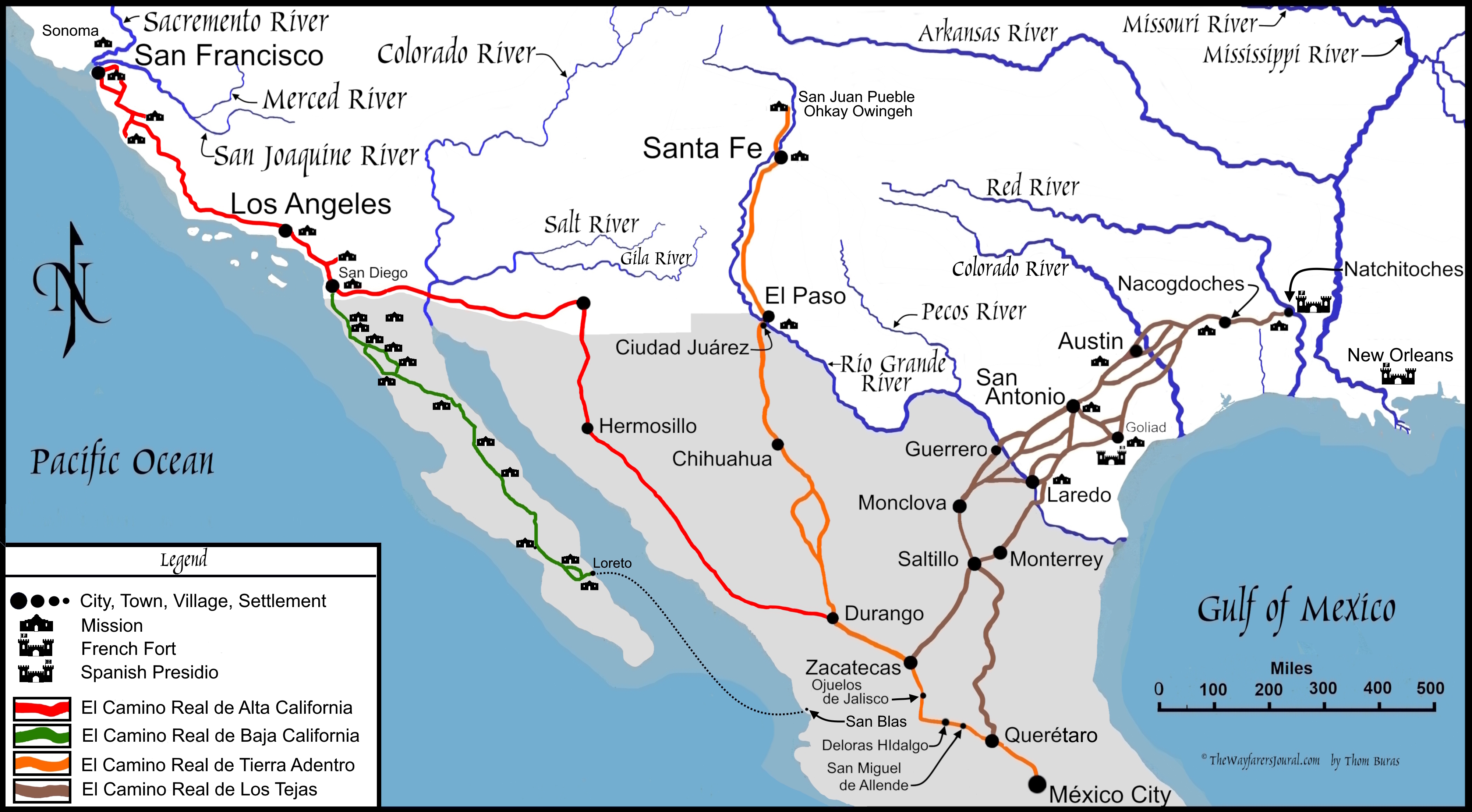
(m0-maps-royal-map) Royal Road de Los Tejas Map
Tbe Royal Road of the Tejas Story:
El Camino Real de Los Tejas (English: Royal Road of the Tejas) initially came into existence beginning 1686 so that the Spanish could locate a French fort built on what the Spanish considered to be their land. Over the next several decades, the De Los Tejas through the state of Texas multiplied along several routes in order to connected important Spanish towns, provincial capitals and forts that held charters from Mexico City granting royal privileges.
The De Los Tejas eventually traverses northeast from the de Tierra Adentro at Zacatecas, through Saltillo, then Monclova, crossed the Rio Grande del Norte at Guerrero, Coahuila and continues northeasterly into Tejas. The route was further refined in 1691-1692 by Domingo Teran del los Rios, the first governor of Spanish Texas, so as to better the connections to the Spanish missions in East Texas. San Antonio de Bexar, founded in 1718 was the first of many way stations along the de Los Tejas road.
El Camino Real de los Tejas was a major roadpath of about 2,500 miles with the destination being the Spanish Texas territory, a pathway spanning the distance from Mexico City to northern Louisiana. This roadpath, upon leaving Mexico City traveled north on the
Mesa Central plateau, then further north on the
Mesa Del North plateau,
After leaving the Sierra Madre Oriental the Spanish explorers would possibly follow one of the many river valleys that lead to the
Rio Grande del Norte. Some of the expeditions arrived at a river ford which later came to be the settlement of Guerro, which is in modern day Coahuila. From this river crossing, the trail entered the territory of the Tejas native Americans, but who were in fact, part of the
Caddoan mound culture. They would use the expression Tejas when encountering the Spanish explorers, a word that in their language means, Friends.
The Path into Texas
The trail in Texas would then follow a path below the
Balcones Escarpment staying within the
Coastal Plains of Texas originally with the purpose of establishing missions in the native villages. Soon, the Spanish towns of
Laredo,
Goliad,
San Antonio,
San Marcus and Austin would appear and begin to grow.
From this location, the section of El Camino Real de los Tejas known as the Camino Arriba, which later came to be known as the Old San Antonio Road, a part of the royal road which stretched from San Antonio, across the Pine Belt to Nacodgoches, then further eastward to cross the Sabine river to arrive in the area of the present day city of Natchitoches, Louisiana on the
Red River.
The Path to Florida
This route was the only overland route from Mexico across the Río Grande to the Red River Valley in Louisiana.
El Camino Real de Los Tejas was used as a thoroughfare from the capital of New Spain to the Spanish colonial area in the province of Texas, and this roadpath was instrumental in the travel, settlement, development, and early history of Texas and Louisiana. Too, I believe that the quest of the Spanish was to eventually connect the Royal Roads to the Spanish settlements in Florida.
The Growth of the Territory
In the early years of Texas, the routes of El Camino Real de los Tejas were the arteries that kept Texas alive. They not only carried information vital to the survival of the province, orders for its administration, reports of danger and appeals for help, but also were the sole paths of commerce throughout the colonial period. Traders, missionaries, and others used this road network which connected Texas to the rest of the Spanish world, and for a time, to French and the Americans in Louisiana in the east.
This El Camino Real was a post road six decades before the Republic of Texas began developing its network of post roads, and it was the primary route for driving cattle and other livestock a century before the Chisholm Trail opened.
Some time later, this road would gain historical significance for its role in the migration of American settlers southwestward into Texas. Communities made improvements along this road, ferries provided transportation at major river crossings and wooden bridges were built.
Many different groups of settlers, called Texians, or sometimes, Texicans came from the east to cross the Red river into what was then still a province of Mexico. Those living in the province of Texas who were of Spanish ancestry were known as Tejanos.
Before Texas became a sovereign state in 1836, Texian referred to any resident, of any race, color or language
By 1821, the people living in Mexico had won its indepencence from Spain and become a sovereign nation. The fledgling government, lead by President Antonio Lopez de Santa Anna, then began a period of political and cultural clashes against the increasing population of Anglo-American settlers in the then northern Mexican province of Texas. Santa Anna believed the United States had instigated the Texas insurrection with the goal of the annexation of Texas. The Mexican Congress passed the Tornel Decree, declaring that any foreigners fighting against Mexican troops will be deemed pirates and dealt with as such, being citizens of no nation presently at war with the Republic and fighting under no recognized flag.
The War
The Mexican government had become increasingly centralized and the rights of its citizens had become increasingly curtailed, particularly regarding immigration from the United States. Mexico had officially abolished slavery in Texas in 1829, and the desire of Anglo Texans to maintain the institution of chattel slavery in Texas was also a major cause of secession.
In 1834, the Texian Army was organized for the Texas Revolution of independence from Mexico. The Texian Army was a diverse group of people from many different nations and states. The Texian Army was composed of Tejano volunteers, volunteers from the Southern United States; and people from England, Germany, the Netherlands, Sweden, Ireland, Scotland, Wales, Portugal, and what is now the Czech Republic. Used in this sense, terms like Texian Army, Texian forces, or Texian troops would refer to any of the inhabitants of Texas, in that era, who participated in the Texas Revolution.
The Revolution began on 02 October 1835 with the Battle of Gonzales. Soon after, the Texians and Tejanos began putting up armed resistance against the Mexican government then headquartered at San Antonio in what came to be called the Siege of Béxar. After this, Santa Anna vowed to personally retake Texas.
Goliad and Alamo
On 18 February 1836, Mexican General José de Urrea led a contingent of 500 soldiers on the Goliad Campaign up the Texas coast, defeating all Texian forces in his path and executing most of those who surrendered. Meanwhile, Santa Anna led a larger force, over 6000 soldiers to San Antonio de Béxar, arriving on 23 February and there with his troops, after a 13 day siege, defeated the Texian garrison in the Battle of the Alamo, killing almost all of the defenders. At 5 am, on 06 March, the Mexican army launched their final assault on the Alamo. After a 90 minute battle, the battle was over and all 200 Texians were dead. Santa Anna had lost upwards of 1000 of his troops. Too, he refused to take any prisoners during the battle and executed any who surrendered.
The battle at the Alamo was in fact militarily insignificant, but what made it remarkable is the enormous political impact that resulted from the circumstances surrounding the events. Travis, in his act of holding the Mexican Army in San Antonio stationary for two week, had effectively succeeded in buying time for the Convention of 1836, scheduled for March 1, to meet. If Santa Anna had not paused in Béxar for those two weeks, he would have reached San Felipe by March 2 and very likely would have captured the delegates or caused them to flee. Instead, the convention was held, the declaration was ratified and signed, thus creating the necessary legal document for the territory to become a free and independent nation called the Republic of Texas.
Washington-on-the-Brazos
On 01 March 1836, the convention at Washington-on-the Brazos was called tot order and the following day, all 59 delegates signed the Texas Declaration of Independence and appointed leadership for the new Republic of Texas. On 06 March, the delegates received a missive from the Texian soldiers besieged at the Alamo, the delegate and commander-in-chief of the Texas Army Sam Houston had his command expanded to include all land forces of the Texian army both Regular, Volunteer and Militia. He then journeyed to Gonzales to take command of the 400 volunteers there waiting for Fannin to arrive and lead them to the Alamo, arriving on 11 March and then within hours of the arrival of Sam Houston, Andres Barcenas and Anselmo Bergaras arrived with news that the Alamo had fallen and all Texians were slain. Houston arrested the two men as spies but a couple of hours after that, upon the arrival of Susannah Dickinson and Joe, the slave of Colonel Travis, both confirmed the report and the two arrested were released.
Realizing that the Mexican army would soon advance towards the Texian settlements, Houston advised all civilians to evacuate and ordered his new army to retreat. At that time, most Texians, including the members of the new government, fled east.
Despite their losses at the Alamo, the Mexican army remaining in Texas outnumbered the Texian army by about six to one. Santa Anna assumed that knowledge of the vast disparity in numbers and the superior battle results of the Mexican army at the Alamo would result in the total suppression of the revolution. Further, when Santa Anna, after his victory, sent the several noncombatants away to Gonzales to spread the word of the Texian defeat. Again, he believed that when the reports of the defeat would go a long way to help Mexico regain control of their province.
However, these tactics only had the opposite result on the Texians, and resulted in the strong rush of many more Texan settlers to join the Texian Army.
Crossing the Brazos
By 19 March, the news of the fall of the Alamo had spread and the volunteer ranks swelled, reaching about 1400 men, but Houston continued to avoid any engagement with the Mexican army, much at the displeasure of his troops. Houston, after learning of the surrender of Fannin, realized that his army was the last hope of an independent Texas, however, he was highly concerned about his how good his ill-trained and ill-discipline force would be to defeat the Mexican army. The Texian army continued to retreat, across the Navidad river, then the Colorado river. Some of the volunteers deserted, some grumbled that their commander was a coward. Upon their arrival at the Brazos river, two companies that refused to retreat any further were assigned to guard the crossing.
On March 31, Houston and his army made the crossing of the Brazos river and near the Groce′s Landing, the Texians rested, recovered from illness, and for the first time began practicing military drills. Then for the next two weeks, the ranks of the Texian army received rigorous military training.
While at camp their on the Brazos, two cannon, know as the Twin Sisters arrived from Cincinnati, Ohio. These two cannons later became instrumental in winning the battle at San Jacinto later. Thomas Rusk, interim Secretary of war and Secretary of state Samuel Carson met with Sam Houston, agreed with Houston′s plans, and Carson even advised Houston to continue all the way to the Sabine river in order that more volunteers from the United States would swell the ranks of the Texian army.
Meanwhile, Santa Anna, who had been underestimating the strength of his foes, further subdivided his troops, leaving a small force at Béxar, then marched to San Felipe and captured a Texian soldier, who informed Santa Anna the Texians planned to retreat further if the Mexican army crossed the Brazos river. On 14 April, Santa Anna led a force of 700 soldiers to capture the interim Texas government at Harrisburg (Houston) and upon their arrival, President Burnet had just shove off in a rowboat bound for Galveston Island. Santa Anna believed that the rebellion was in its final death throes and that the Texian government had been forces off the mainland with no way to communicate with its army, nor had the army shown any interest in fighting.
Proceed to Lynchburg
Santa Anna determined to block the retreat of the Texian army and put a decisive end to the war. Santa Anna determined to block the retreat of the Texian army and put a decisive end to the war. His scouts had reported that the Texian army was going to Lynchburg Crossing on Buffalo Bayou and assumed that this was in preparations for their joining the government in Galveston. So on 15 April, Santa Anna burne Harrisburg and afterwards pressed on toward Lynchburg.
In fact, the Texian army had only just resumed their eastward march, and on 16 April, take the southern road to Harrisburg arriving on 18 April, just after Santa Anna left towards Lynchburg. Two of Houston′s scouts, Deaf Smith and Henry Karnes are able to capture a Mexican courier carrying intelligence on the locations and plans of all of Santa Anna′s troops. Houston, upon realizing that Santa Anna only has 700 troops with him and was not far away, gives a rousing speach to his men, exhorting them to Remember the Alamo and Remember Goliad. He then fast marches his army towards Buffalo Bayou arrive at a location near to the Lynch′ ferry at nine in the morning of 20 April, beating Santa Anna′s arrival by a couple of hours. Houston makes camp in a wooded area along the bank of Buffalo Bayou, which location provided good cover helping to hide their full strength.
Santa Anna chooses to make camp on a plain near the San Jacinto River, bordered on one side by woods with a marsh and lake on the other. The two camps were separated by some 500 yards, (one third mile) with a grassy area having a slight rise in the middle between the two camps.
Battle of San Jacinto
On April 21, Houston′s army staged a surprise assault on Santa Anna and his vanguard force at the Battle of San Jacinto. The Mexican troops were quickly routed, and vengeful Texians executed many who tried to surrender. Santa Anna was taken hostage; in exchange for his life, he ordered the Mexican army to retreat south of the Rio Grande. Mexico refused to recognize the Republic of Texas, and intermittent conflicts between the two countries continued into the 1840s.
Following the war between the United States and Mexico, the Old San Antonio Road was noted for its role as a trade route for cotton, supplies and troops. Eventually, use of El Camino Real de los Tejas and the Old San Antonio Road diminished as the growth of towns such as Austin, Galveston and Houston as well as the building of railroads, all changed the direction of travel and trade between the United States and Mexico.
This road directly influenced the growth of several Texas towns and cities, while surviving segments formed part of our modern road system. Today’s travelers can enjoy their own royal road trip, planning stops at historical sites and other points of interest. The routes of El Camino Real de los Tejas were the arteries that kept Texas alive.
|