|
The California quail, also known as the Valley quail, is a small ground-dwelling bird in the New World quail family, Odontophoridae.
The California quail is the state bird of California, established as such in 1931. Once plentiful in San Francisco, by 2017, the population was reduced to only one male bird, which was named Ishi after the last known member of California′s Native American Yahi tribe.
Taxonomy:
Kingdom:
Animalia
Phylum:
Chordata
Class:
Aves
Order:
Galliformes
Family:
Odontophoridae
Genus:
Callipepla
Species:
C. californica
Common Name:
California Quail
Conservation Status:
LC
Subspecies:
seven
C. c. califonica, Type species. coastal CA, Coronado I.
Introduced: coast OR, coast WA. W. NV
C. c. achrustera, San Lucas quail, Baja CA
C. c. brunnescens, N. coast CA, south to Santa Cruz County
C. c. canfieldae, Owen Valley quail, Owens Valley in E.Cn. CA
C. c. catalinensis, Santa Catalina quail, Santa Catalina I.
C. c. orecta, Warner Valley quail, Warner Valley, OR to N. CA
C. c. plumbea, San Quintin guail, San Diego Co., CA to BS, MEX
Description
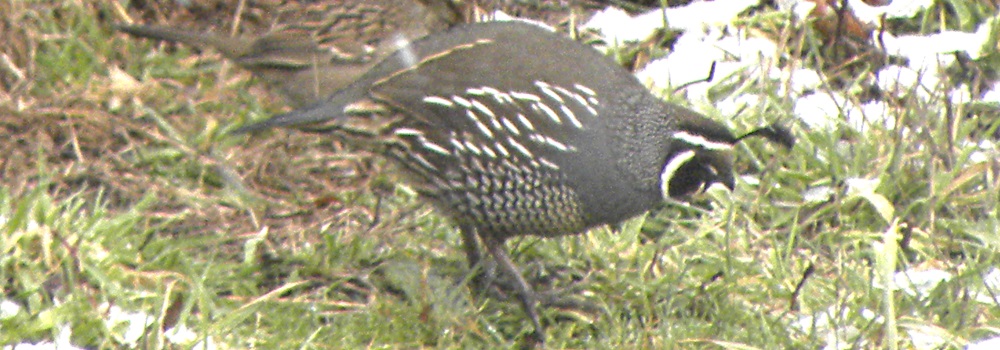
The California quail have a curving crest or plume, made of six feathers, that droops forward. These birds are very timid.
Length:
10 inches
Wingspan:
inches
Male:
Males have a black plume, bold head pattern with a dark brown cap and a black face. The males have a brown back, a grey-blue chest, and a light brown scaled belly. The flanks are brown with white steaks.
Some coastal birds are slightly browner.
Female:
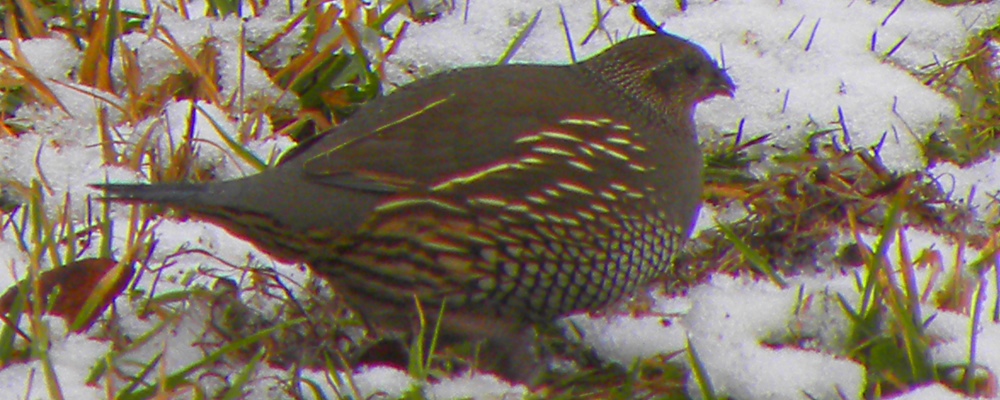
Female have a brown plume, somewhat shorter that the male and lacks the distinct head pattern of males.
Females are mainly grey-brown with a light-colored belley
Juvenile:
Young birds, like the females have a shorter plume, lacks the distinct head pattern of males and are grey-brown in color.
Habitat:
Numerous and widespread from wet coastal brush to dry chaparral, suburban parks and gardens. Roosts in trees or brush.
Range:
Year-round:
Found west of the Rocky Mountains, from southern California to British Columbia. Also in eastern Washington, Oregon, southern Idaho, northern Nevada and northern Utah.
Breeding:
Their breeding habitat is shrubby areas and open woodlands. The nest is a shallow scrape lined with vegetation on the ground beneath a shrub or other cover.
|