|
The fog bow is a similar phenomenon to a rainbow, but, as its name suggests, it appears as a bow in fog rather than rain. Because of the very small size of water droplets that cause fog (drops smaller than 0.05 millimeters or 0.0020 in), the fog bow has only very weak colors, with a red outer edge and bluish inner edge.
Fog bows are always opposite the sun like primary and secondary rainbows, and are almost as large but much broader.
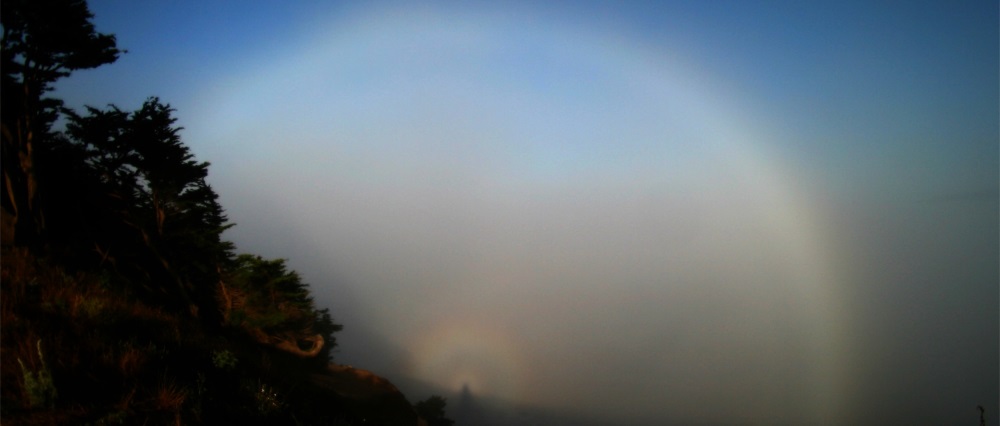
(m5ph-rainbow-fog-bow) Fog Bow, (also called Spectra)
photo credit: Wikimedia commons
Viewing Fog Bows
Fog bows can be seen on hills, mountains, cold sea mist or anyplace where there is a thin fog and fairly bright sunshine. Fog bows light source can be the sun, moon or even car headlights. When you see the sun breaking through the mist, look at an angle of 35° or more from your shadow which marks the antisolar point. Often, a fog bow will have a low contrast to the surrounding area so look for small bright spots in the background fog.
The sun must be less than thirty of forty degrees high, (three of four hands) with the exception if you are standing in a place of high elevation and looking down into a valley.
When you do see a fog bow, look to the center of the bow for the
spectre which is manifested by the same light scattering process.
|