|
Reflection verses Reflected Rainbows
A reflection rainbow can occurs when sunlight reflects off a large body of water before reaching the raindrops. If the body of water is calm over the entire surface and is close to the rain curtain, then a reflection bow will appear above the horizon. Reflection bows intersect the primary (and secondary) rainbow at the horizon with an arc which reaches higher into the sky.
This reflection of sunlight from smooth water sends parallel shafts of light upwards, which to falling raindrops appears like a second sun shining upwards from below the horizon. The anthelic point, which is the same distance above the horizon as the antisolar point is below it, is the center of the reflection rainbow.
Reflection Rainbow
The large body of water that reflects the sunlight to form the reflection bow does not have to be behind the observer, however, when it is in front of the observer, only the lower parts of the reflection bow will be visible.
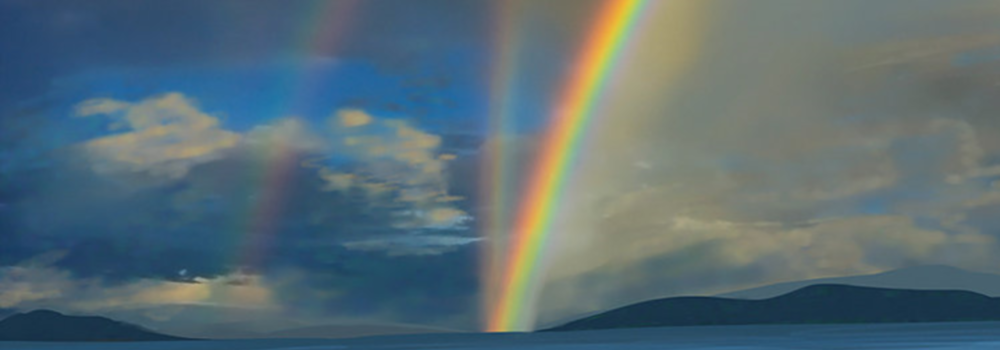
(m5ph-rainbow-reflection-bow) Double Bow w/ Reflection Bow
photo credit: Allen McCloud
Reflected Rainbow
A reflected rainbow (see below photo) appears in the water surface below the horizon. The sunlight first passes through the raindrops to form the primary (secondary and possibly other) rainbow(s). Then the rainbow(s) is(are) reflected off the body of water below, all before reaching the observer.
A reflected rainbow can be visible in full or partially, but often at least partially, even in small water puddles.

(m5ph-rainbow-reflection-reflected-bow) Reflected in water
photo credit: Gerrit Doeksen
Viewing Reflection and Reflected Rainbows
The number one requirement that brings on both reflection and reflected rainbows is the proximity of a large calm body of water from which sunlight can be reflected.
Look for reflections bows near either coasts and large lakes.
|